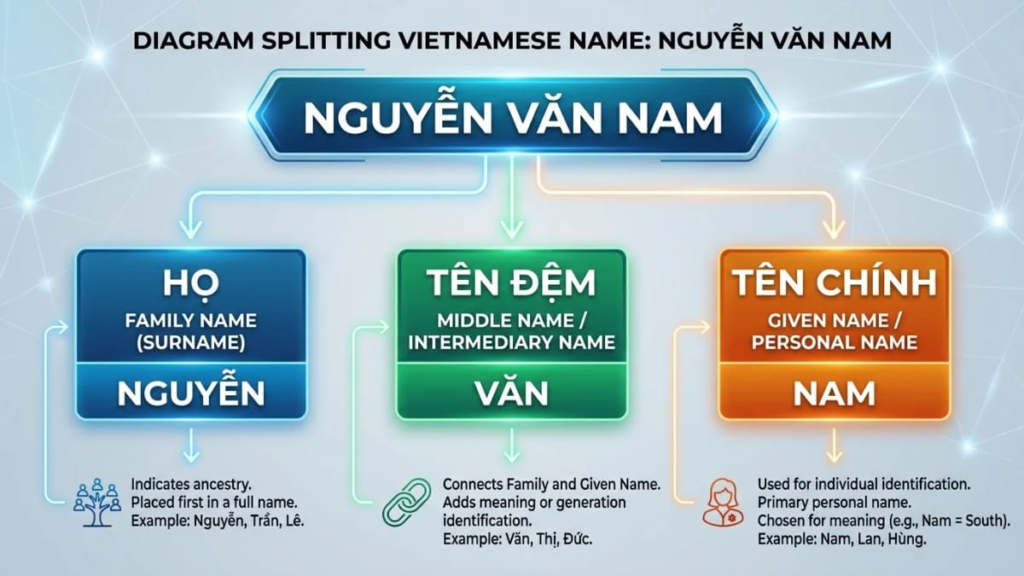

Vietnamese names put the family name first, followed by the middle name and then the given name. In Nguyễn Văn Nam, Nguyễn is the family name, Văn is the middle name and Nam is the given name. Once you know that order, the rest of the system starts to make sense.
This guide explains how Vietnamese names are built, which surnames are most common, and what popular girl and boy names mean. It also covers tone marks, home nicknames and naming customs, with practical tips if you are choosing a name or writing a character.
One note on meanings: many Vietnamese names have Sino-Vietnamese roots, and a single spelling can carry more than one meaning depending on the tone mark and the original word. Where sources differ, this article gives the most widely stated meaning.
How Vietnamese Names Are Built
Vietnamese names usually has three parts, though it can run from two to five words depending on how many words sit in the middle and given name. The table below breaks down one example.
| Part | Position | Example: Nguyễn Văn Nam |
| Family name (họ) | First | Nguyễn |
| Middle name (đệm) | Second | Văn |
| Given name (tên) | Last | Nam |
The family name is inherited, traditionally from the father. The middle name can separate people who share the same first and last name, honour ancestors, or hint at gender. The given name is the part people actually use in daily life.
Some people have no middle name at all, as in Lê Dũng. Two-word given names also exist and are more common for women.
This order can look backwards to English speakers. Like Chinese and Korean names, Vietnamese names start with the family name, which is the reverse of the usual English pattern.
How People Are Addressed
In daily life, people are addressed by the given name, usually with a title. A man named Nguyễn Văn Lu, for example, would be called Mr. Lu. Calling someone by their family name is rare, even though it comes first on paper.
The Most Common Vietnamese Surnames
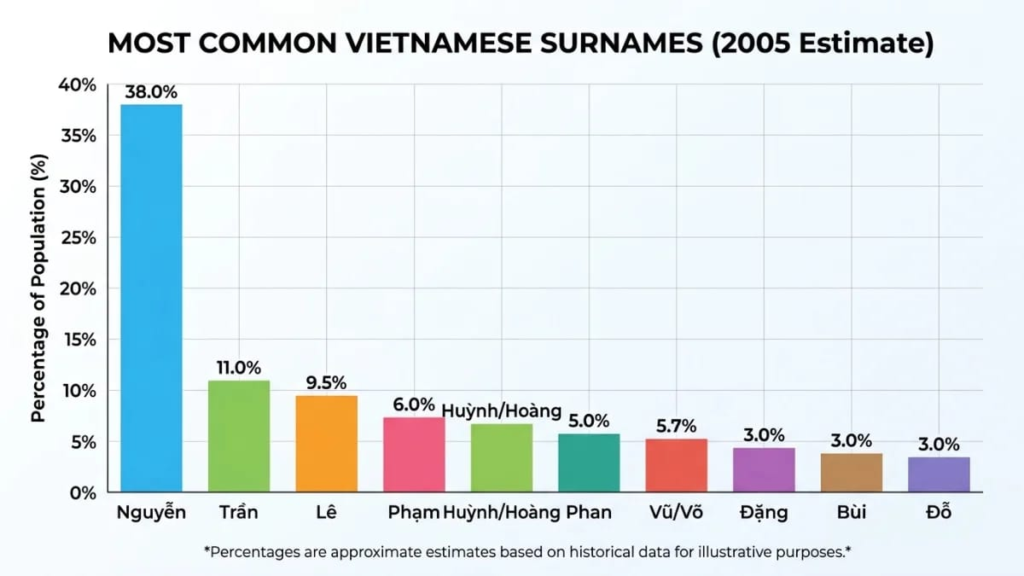
Vietnamese names have far fewer surnames than most countries. More than 90 percent of the population shares about 15 last names.
One widely quoted 2005 estimate puts Nguyễn at nearly 38 percent, Trần at nearly 11 percent and Lê at 9.5 percent. Other sources place Nguyễn anywhere between 30 and 40 percent, so treat every figure here as approximate.
| Surname | Approx. share (2005 estimate) |
| Nguyễn | ~38% |
| Trần | ~11% |
| Lê | ~9.5% |
| Phạm | ~7.1% |
| Hoàng / Huỳnh | ~5.1% |
| Phan | ~4.5% |
| Vũ / Võ | ~3.9% |
| Đặng | ~2.1% |
| Bùi | ~2% |
Why Nguyễn Is So Dominant
Popular explanations point to the Nguyễn dynasty, the last royal family, and to historical migration and name changes. Historians debate the details, so it is safer to say the cause is a mix of history and prestige.
In practice, a family name alone rarely identifies anyone in Vietnam. People rely on the middle and given names to tell each other apart.
Văn and Thị: What Middle Names Reveal
Văn is the classic middle name for men and Thị for women. Seeing either one in a list often tells you the gender before you know anything else.
Among older generations, women’s middle names were almost always Thị, while men often had Văn, Công, Đức, Hữu, Quang or Thanh. Today many parents prefer other or longer middle names, such as Hoàng Minh in Lê Hoàng Minh Thảo.
Middle names can also mark a generation, and siblings in a family may share the same one. Think of Văn and Thị as clues in older records rather than rules for modern names.
Full Name Examples and How to Read Them
| Full name | Family | Middle | Given | Note |
| Nguyễn Thị Lan | Nguyễn | Thị | Lan | Classic female pattern |
| Trần Văn Hùng | Trần | Văn | Hùng | Classic male pattern |
| Phạm Minh Châu | Phạm | Minh | Châu | Modern middle name |
| Lê Hoàng Minh Thảo | Lê | Hoàng Minh | Thảo | Two-word middle |
| Lê Dũng | Lê | None | Dũng | No middle name |
Vietnamese Girl Names and Their Meanings
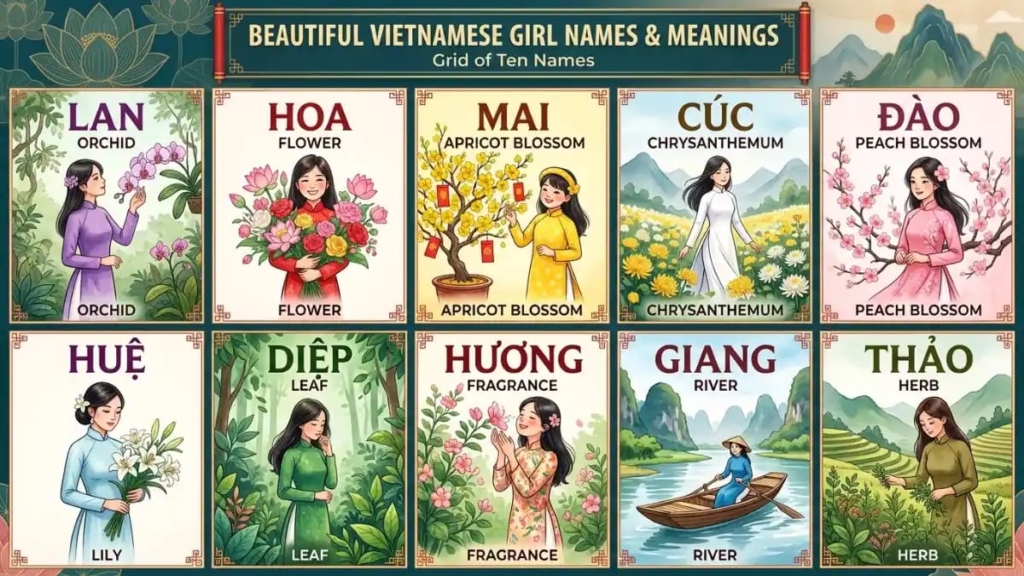
Girl names lean toward flowers, light and gentle qualities. Vietnamese names are grouped by theme below so you can shortlist by feeling, not only by sound.
Flowers and Nature
- Lan – orchid
- Hoa – flower
- Mai – apricot blossom, often translated as plum blossom
- Cúc – chrysanthemum
- Đào – peach blossom
- Huệ – lily
- Liên – lotus
- Sen – lotus
- Quỳnh – a night-blooming flower
- Diệp – leaf
- Hương – fragrance
- Giang – river
- Thảo – herb or grass, often understood as kind and respectful
Mai and Đào are both tied to Lunar New Year. The yellow apricot blossom is popular in the south and peach blossom in the north.
Seasons, Sky and Water
- Xuân – spring
- Thu – autumn
- Vân – cloud
- Tuyết – snow
- Sương – dew or mist
- Nguyệt – moon
- Thủy – water
Light and Treasure
- Ánh – light
- Ngọc – jade or gemstone
- Bích – jade
- Châu – pearl
- Hằng – moon
- Linh – spirit, soul
Gentle Character
- An – peace
- Yên – calm and peaceful
- Hiền – gentle, quiet
- Hạnh – virtue
- Hân – joyful
- Duyên – graceful
- Dịu – gentle
- Diệu – charming
- Mỹ – beautiful
- Phương – fragrant, also read as direction
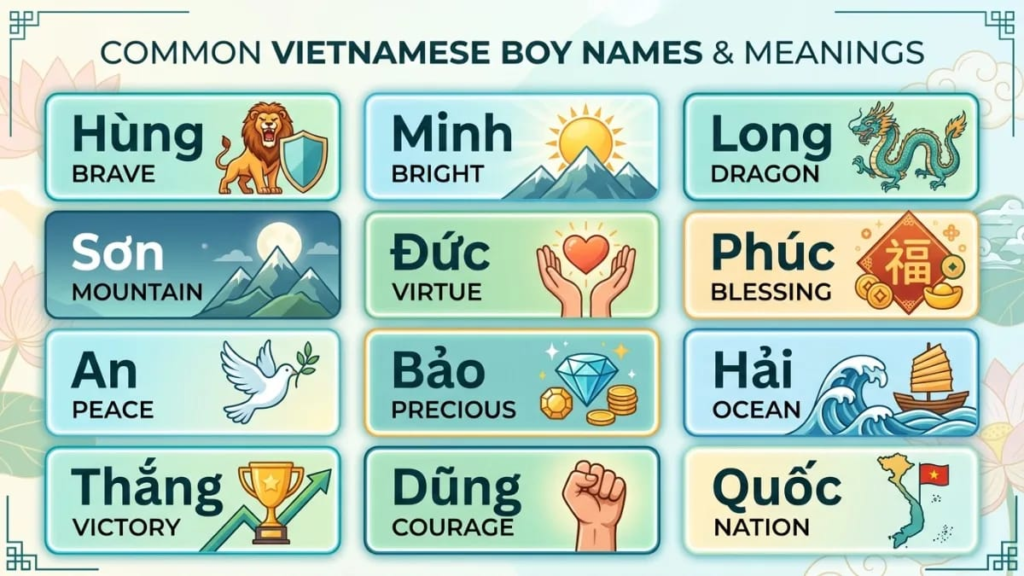
Vietnamese Boy Names and Their Meanings
Boy Vietnamese names often express hopes for strength, intelligence and success. Parents may choose names like Hùng, Dũng or Mạnh hoping for a strong, brave and successful son.
Strength and Courage
- Hùng – brave, heroic
- Dũng – courageous
- Mạnh – strong
- Cường – strong, powerful
- Long – dragon
- Kiệt – hero
- Thắng – victorious
- Khải – victory
Wisdom and Light
- Minh – bright, clever, intelligent
- Quang – radiant, bright
- Trí – wisdom
- Khôi – handsome
- Tuấn – talented, handsome
- Nguyên – origin, first
Virtue
- Đức – virtue
- Nghĩa – righteousness
- Trung – loyal
- Tín – trustworthy
- Khiêm – humble
- Nhân – kind, benevolent
- Liêm – pure, honest
- Hiếu – filial, dutiful to parents
- Thiện – good, kind
- Tâm – heart
- Bình – peaceful
Success and Fortune
- Thành – successful
- Vinh – glory
- Huy – glorious
- Phúc – blessing, good fortune
- Bảo – treasure, also read as protect
- Lộc – prosperity
- Thịnh – prosperous
- Khang – healthy, prosperous
- Toàn – complete, whole
Nature
- Nam – male, also south
- Sơn – mountain
- Hải – ocean
- Lâm – forest
- Tùng – pine tree
- Phong – wind
Unisex Vietnamese Names
Vietnamese names work for either gender, and the middle name or the full combination usually shows which is meant.
- Minh – mostly used for boys, but girls can carry it in combinations such as Minh Châu.
- Anh – used for both genders, though more often for boys. Sources disagree on its meaning, with readings such as hero, brother or peaceful.
- Linh – spirit or soul, found on both boys’ and girls’ lists.
- An – peace, used for both.
Why Tone Marks Change a Vietnamese Names
Vietnamese names has six tones in its standard northern form, and the marks above or below a letter change the word. That is why Yên and Yến are different names: Yên means peaceful, while Yến means swallow, the bird.
Not every mark is a tone mark. The hat on the ê in Yên changes the vowel, and the tone stays level. Yến keeps the hat and adds an acute accent, which changes the tone and the meaning.
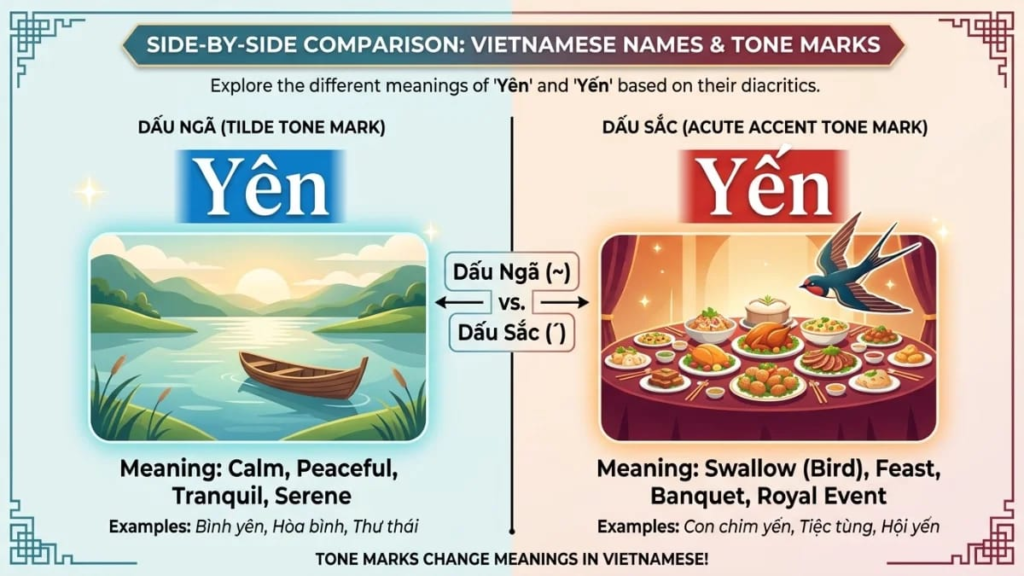
Dropping the marks, as many English-language sites do, blurs these differences. If you are choosing a name, ask a Vietnamese speaker to confirm the exact spelling and meaning.
Writing and Pronouncing Vietnamese Names in English
Pronunciation varies by region. Nguyễn, for instance, is often rendered roughly as “nwin” in English, but northern and southern speakers say it differently.
English forms ask for a first name, which for a Vietnamese person means the given name at the end. Many people living abroad reorder their name to fit, for example writing Nam Nguyen, and some keep the middle name while others drop it.
Sino-Vietnamese and Native Vietnamese Names
Many Vietnamese names come from Sino-Vietnamese words, which are Vietnamese readings of Chinese-origin vocabulary. Others use native Vietnamese words, and some meanings exist in both forms.
Lotus is a good example. Liên is the Sino-Vietnamese word, while Sen is the native one. The same pattern shows up with cloud, where Vân is Sino-Vietnamese and Mây is the native word.
This helps when a name seems to have two meanings. Check which word the family intended, because the spelling, tone and origin all point to different ideas.
Home Nicknames
Many Vietnamese children also have a nickname used at home, separate from the official name. Traditionally, some families chose plain or even humble nicknames, often explained by an old belief that a modest name would keep a child safe.
Today the practice is usually affectionate rather than superstitious. It is worth knowing if a Vietnamese friend is called something different by family.
Naming Customs Worth Knowing
- No naming after elders. Traditionally, a child is not named after their parents or older relatives.
- Women keep their names. Women do not change their legal name after marriage.
- Religious names. Some people also hold a ceremonial name, such as a Buddhist Dharma name or a Catholic saint’s name, used for religious purposes.
- Meaning matters. Names are chosen to express the family’s hopes for the child.
Common Mistakes When Using Vietnamese Names
- Using the family name alone. Calling Nguyễn Văn Lu Mr. Nguyễn sounds odd, because the given name is the usual form of address.
- Treating Thị as a first name. It is a middle name, so Nguyễn Thị Lan is called Lan, not Thị.
- Assuming the same surname means the same family. With so many people sharing Nguyễn, the surname alone says very little.
- Dropping tone marks without checking. Yên and Yến show how much meaning can be lost.
How to Choose a Vietnamese Name
- Pick the meaning first. Decide whether you want strength, gentleness, nature or luck, then shortlist from that theme.
- Check the full combination. Say the family, middle and given name together, since the rhythm and meaning of the whole name count.
- Confirm tone marks. Have a native speaker verify spelling and meaning before you commit.
- Think about English speakers. Families living abroad sometimes avoid names that English speakers tend to mispronounce, such as Phúc.
If You Are Writing a Character
Put the family name first and use Văn or Thị as a realistic middle name for an older character. Nguyễn is the safest realistic surname. For a younger character, a middle name such as Minh or Hoàng Minh feels more current.
Final Thoughts
Vietnamese names are easier to read once you see the pattern: family name, middle name, given name. The surname is shared by millions, the middle name is a clue, and the given name carries the personal meaning.
If you are picking a name, start with the meaning you want and check the tone marks with a native speaker. That one step avoids most spelling and meaning mistakes.
For writers, researchers and parents alike, the safest habit is to treat each name as three separate clues instead of one label. Read the family name for lineage, the middle name for generation or gender, and the given name for the meaning the family chose.
FAQs
What is the most common Vietnamese surname?
Nguyễn, shared by roughly 30–40% of the population, depending on the estimate.
Which part of a Vietnamese names comes first?
The family name, followed by the middle name and then the given name.
What do Văn and Thị mean?
They are traditional middle names for men (Văn) and women (Thị). They mark gender rather than carry a fixed meaning, and many families now use other middle names.
Do Vietnamese women change their name after marriage?
No. Their legal name stays the same.
How do Vietnamese people address each other?
By given name, usually with a title, so Nguyễn Văn Lu would be called Mr. Lu.
Can a Vietnamese name have no middle name?
Yes, though it is uncommon. Lê Dũng is one example.
Why do tone marks matter in names?
They change the meaning. Yên means peaceful, while Yến means swallow.
Are there Vietnamese names for both boys and girls?
Yes. Minh, Anh, Linh and An are used for both, and the middle name usually shows which is meant.