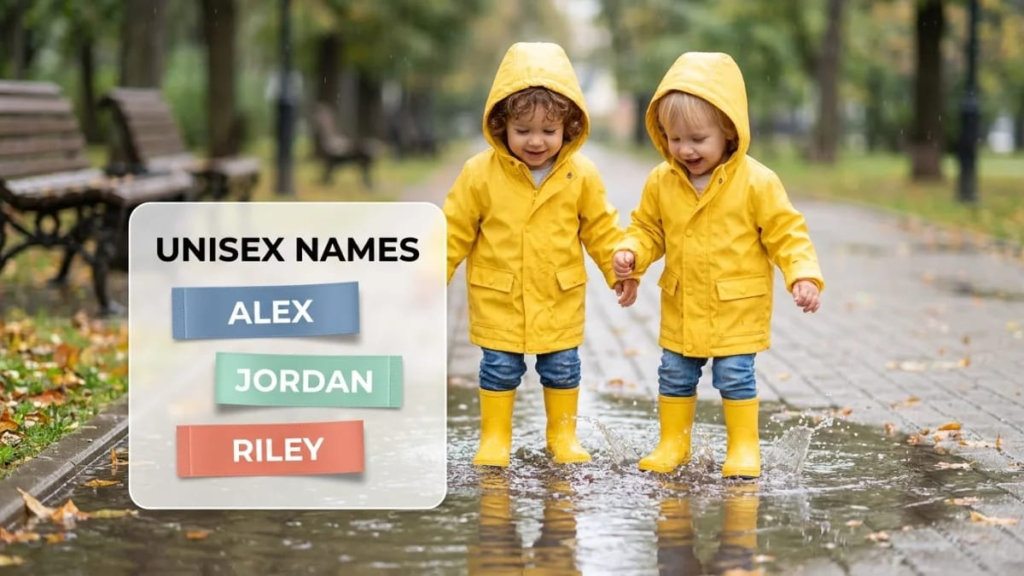

Unisex names are first names that people of any gender can carry, like Alex, Jordan or Riley. They used to sit at the edge of baby-name lists, but now many parents look for them on purpose.
Some want a name that works before the baby is born. Others simply like a name that sounds light, modern and easy to say. Whatever the reason, this guide gives you 50 picks with origins and meanings, plus the background you need to choose well.
Quick answer: Unisex names are first names used for people of any gender, such as Alex, Jordan, Riley or Quinn. Some are split almost evenly between girls and boys, while others lean one way in practice. Many began as surnames, nature words or nicknames, and they appear in cultures all over the world.
What Are Unisex Names?
Unisex names are names that are used for both girls and boys. You may also see the terms epicene, gender-neutral or androgynous used for the same idea.
Many unisex names are short forms of longer, gendered names. Alex, for example, can come from Alexander or Alexandra, and Sam can come from Samuel or Samantha.
These unisex names are especially common in English-speaking countries. In some other countries, though, the law asks parents to choose a name that clearly signals a child’s sex, so it is worth checking the rules where you live.
Unisex Names vs Gender-Neutral Names
The two terms sound the same, but they are not always the same thing. Names can be unisex names on paper and still feel male or female to most people who hear it.
Name sites usually measure this with a simple split. Here are the rules of thumb you will see most often.
| Test | What it checks |
| At least 10% rule | The less common gender receives at least 10% of the babies given the name |
| 95% rule | No more than 95% of babies with the name are one gender |
| Four-to-one gap | One gender gets the name four times as often as the other, so it counts as unisex but still reads as gendered |
The practical lesson is simple. If you want a name that nobody assumes anything about, look for a close split, not just a name that appears on a unisex list.
If you are happy with a name that leans slightly one way, you have far more choice. Most names in this guide sit somewhere in the middle.
Where These Unisex Names Come From
Most of them did not start out as unisex names. They arrived through a few common routes.
- Surnames that became first names, such as Parker and Avery
- Nicknames and short forms, such as Charlie and Sam
- Nature words, such as River and Wren
- Occupational names, such as Taylor and Harper
- Names borrowed across languages, such as Andrea and Jean
Surnames deserve a closer look. Families often passed on a mother’s maiden name as a child’s first name, which is one reason so many surnames now work as given names.
Names also change sides over time. A name starts as male, becomes unisex for a while, and often ends up mostly female. Researchers who have studied them report that this path is more common than the reverse.
| Name | How it changed |
| Shirley | Began as an English surname and a boy’s name, then turned into a girl’s name, often credited to an 1849 novel |
| Leslie | Used for boys in Scotland and England, now more common for girls in many countries |
| Evelyn | Once a familiar boy’s name in England, now mostly given to girls |
| Ashley | Started as a surname and a boy’s name, then became popular for girls in recent decades |
Ryan and Rory show the path in the other direction. Both were long used for boys, and both are now given to girls often enough to count as unisex.
One more number is worth knowing. A Nameberry and New York Times analysis reported that use of unisex baby names rose by approx. 88% between 1985 and 2015.
Classic Picks
Classic picks have been in use for generations. They are familiar, easy to spell and rarely need explaining.
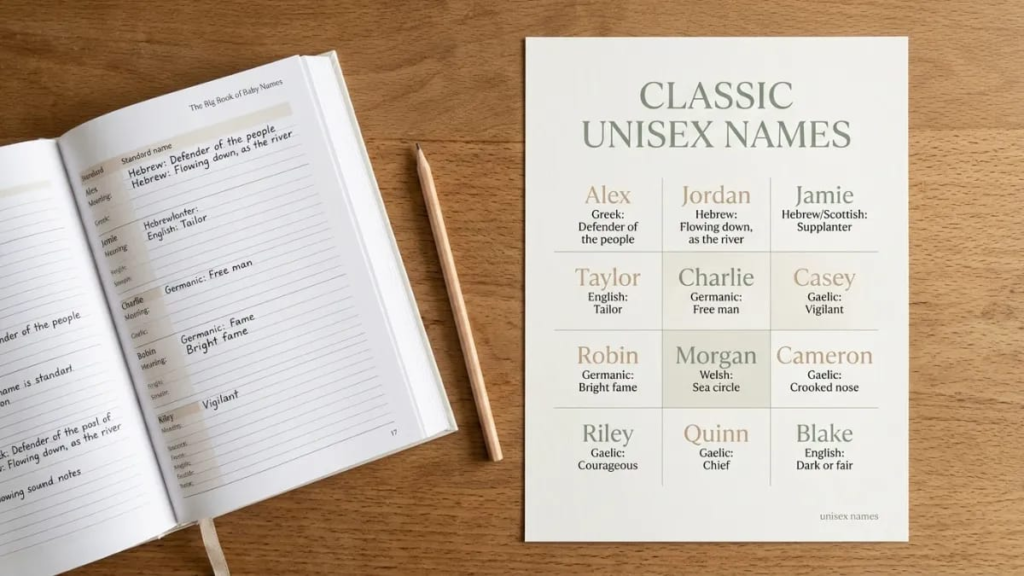
| Name | Origin | Meaning |
| Alex | Greek | defender of mankind |
| Jordan | Hebrew | flowing down |
| Jamie | Hebrew, Scottish | supplanter |
| Taylor | English | tailor |
| Charlie | Germanic | free man |
| Casey | Irish | watchful |
| Robin | Germanic | bright fame |
| Morgan | Welsh | sea-born |
| Cameron | Scottish | crooked nose |
| Riley | Irish | valiant |
| Quinn | Irish | wise, chief |
| Blake | English | dark or pale |
Blake is an interesting case, because the old English roots can point to either black or pale. Both meanings are given in name books, so you can pick the one you prefer.
Morgan is often explained as sea-born, though a few sources give related meanings. Casey and Riley also have more than one reading, so it is worth checking a couple of sources.
Nature-Inspired Unisex Names Picks
Unisex names have a calm, outdoor feel. They also tend to be gender-neutral in sound, since a tree or a bird has no gender at all.
- River (English): flowing water
- Rowan (Irish, English): rowan tree, also read as little red one
- Sage (Latin): wise, also the herb
- Wren (English): a small songbird
- Ash (English): ash tree
- Aspen (English): aspen tree
- Sky (English, Norse): the sky
- Indigo (Greek): deep blue dye
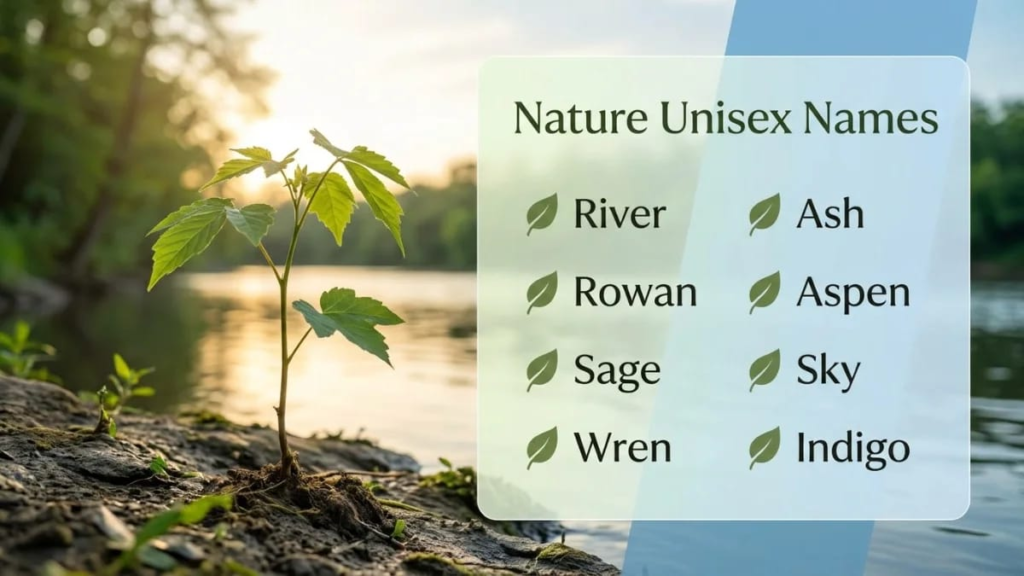
River, Wren and Rowan are the easiest to spot on a school register. Aspen and Indigo are less common, so they suit parents who want something that stands out. Short, soft sounds such as the r in River and Rowan also help these names feel gentle in either voice.
Surname and Place Picks
Surnames are the biggest source of modern gender-neutral picks. They sound smart and a little formal, which balances a soft first impression.
- Parker (English): park keeper
- Avery (English): elf ruler
- Harper (English): harp player
- Emerson (English): son of Emery
- Finley (Scottish): fair warrior
- Dakota (Sioux): friend, ally
- Reese (Welsh): ardour, enthusiasm
Many of these are used more for one gender in some years and the other in different years. That is the kind of drift described earlier, so check recent data for your own country before you decide.
Vintage-Style Unisex Picks
Some old names are being rediscovered as gentle, gender-open options. They have a soft, slightly literary sound.
- Hollis (English): holly trees
- Ellis (English): a form of Elijah, meaning Yahweh is my God
- Emery (Germanic): industrious ruler
- Arden (Latin): ardent, fiery
- Sloane (Irish): raider
- Gray (English): the colour grey
Picks With Strong Meanings
If you want a name that carries a message, these options come from the lists above. Each has a meaning linked to strength, care or wisdom.
- Alex: defender of mankind
- Finley: fair warrior
- Sloane: raider
- Casey: watchful
- Riley: valiant
- Quinn: wise, chief
- Emery: industrious ruler
A short meaning is easy to share with relatives and teachers. It also gives your child a small story to tell about the name.
Short and Simple Picks
Short names are quick to say and easy to write. They also pair well with a longer middle name.
| Name | Origin | Meaning |
| Kai | Hawaiian | sea |
| Lee | English | meadow |
| Sam | Hebrew | short for Samuel or Samantha |
| Jo | Hebrew | short for Joseph, Joanna or Josephine |
| Ari | Hebrew | lion |
| Eden | Hebrew | delight |
| Remy | French | oarsman |
| Rio | Spanish | river |
| Pax | Latin | peace |
Kai has roots in several languages, including Hawaiian, so the meaning depends on the family you are drawing from. Pax is rare but easy to pronounce, which makes it a good pick if you want something short and unusual.
Unisex Names From Around the World
Unisex naming is not only an English habit. Many cultures have names that are used for everyone.
Some Indian names, such as Kiran, Jyoti and Shashi, are commonly used for both men and women. Modern Hebrew also has many names used for any child, and the Shona people of Zimbabwe give meaning-based names that are often unisex.
| Name | Culture | Meaning |
| Haru | Japanese | spring, sun or clear, depending on the characters |
| Hikari | Japanese | light |
| Kiran | Sanskrit | ray of light |
| Jyoti | Sanskrit | light, flame |
| Noor | Arabic | light |
| Ayo | Yoruba | joy |
| Imani | Swahili | faith |
| Iolani | Hawaiian | royal hawk |
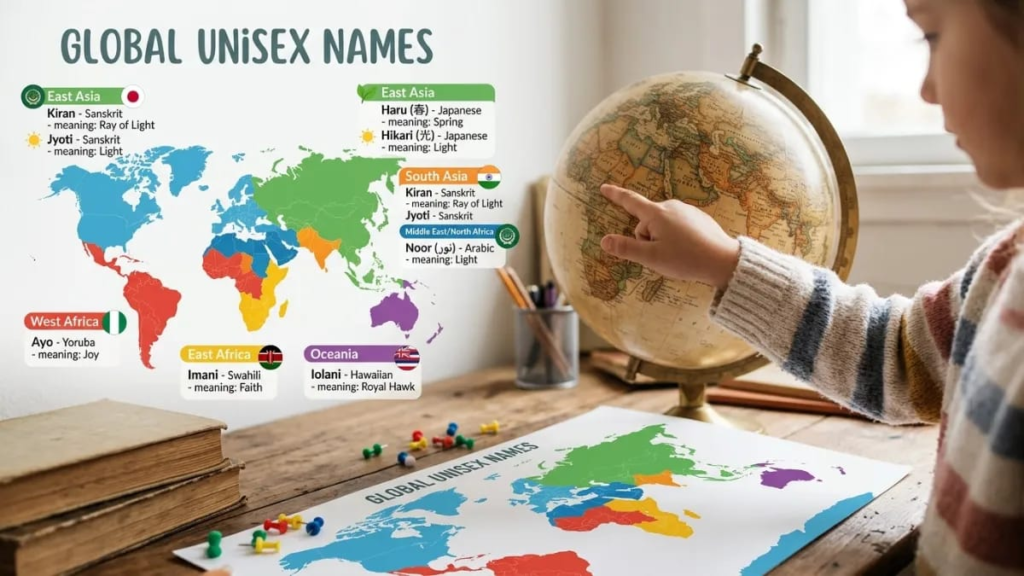
Japanese names are a good example of why meaning depends on spelling. The same sound can be written with different characters, and each choice changes the meaning, so check the exact characters before you settle on one.
When a Name Changes Gender Across Borders
A name can be unisex in one place and clearly gendered in another. This matters if your family moves, travels or has relatives in different countries.
| Name | How it is used |
| Andrea | Male in Italy, usually female in Spain and in many English-speaking countries |
| Nicola | Male in Italy, usually female in the UK and Ireland |
| Simone | Male in Italy, female in France |
| Jean | Male in France, often female in English-speaking countries |
| Sasha | Used for both boys and girls in Russia, as a short form of Alexander or Alexandra |
Sasha is a useful reminder that a pet form can be unisex from the start. The longer names behind it are gendered, but the short form is shared.
Choosing a Unisex Name as an Adult or for a Character
People look up these names for reasons beyond babies. Some adults are choosing a new name, and many writers want a name that fits a character without pointing to a gender.
A few ideas help in both cases.
- Say the name aloud with the surname and in a full sentence
- Try it in an email address and a signature to see how it reads
- Look at the culture and period it comes from, especially for a fictional character
- Check that the meaning fits the person or the story
- If you are changing your own name, check the legal steps in your country
Quinn, Rowan, Sasha and Jordan are common choices because they feel natural in many settings. A less common option, such as Wren or Ellis, gives a name more personality.
Are There Any Downsides?
Gender-open names are not risky, but they do come with a few practical points. Knowing them in advance makes the choice easier.
- People may guess a gender when they read the name on a form or email
- A name that is common for one gender in your area may feel less neutral than it looks
- Spelling can vary, so you may need to correct it now and then
- Names from other cultures may be mispronounced until people learn them
On the other side, a name that fits any gender never boxes a child in. It also stays comfortable as the person grows up.
How to Choose Unisex Names for Your Baby
Picking a name is partly about taste and partly about checking a few facts. These steps help you avoid surprises.
- Say the full name aloud with your surname
- Look up the gender split in your country’s official baby-name data
- Check nicknames and short forms, since many of them come from longer gendered names
- Choose one spelling, such as Jamie or Jaime, and use it everywhere
- Read the meaning in more than one source
- Decide how much gender signal you want, and use the middle name for it if needed
- Check local naming rules if you live outside an English-speaking country

Here is a quick example. If you love Rowan, check whether it leans one way in your area, try it with your surname, and test a few middle names. Charlie is another case, since it can be short for Charles, Charlotte or Charlene, so the nickname may carry more meaning than the full name.
Sibling names are worth a thought too. Matching style, such as two nature names, feels connected without forcing a theme.
Common Mistakes to Avoid
A few slips come up again and again when parents pick a name from a list.
- Choosing a name only because it appears on a unisex list, without checking the real split
- Ignoring nicknames, which may sound very different from the full name
- Forgetting to check the initials with the surname
- Assuming a name means the same thing in every culture
- Mixing two spellings in different documents
Middle Name Pairings
A middle name can add weight, softness or tradition. Here are a few pairings built from the names above.
| First name | Middle name | Feel |
| Rowan | James | Calm and classic |
| Quinn | Elise | Crisp and soft |
| River | Jane | Simple and plain |
| Wren | Everett | Light and strong |
| Avery | Lee | Short and easy |
| Ellis | Margaret | Warm and vintage |
A longer middle name balances a short first name, and a short one balances a long first name. Say the full name out loud to check the rhythm.
Final Thoughts
These names give you room to choose a name for how it sounds and what it means, rather than for a category. They come from surnames, nature, nicknames and many cultures, so there is a lot to explore.
Remember that unisex does not always mean gender-neutral. Check a name’s real usage, read more than one meaning and say the full name aloud. The right choice is the one that still feels good years from now. Take your time, read the lists twice and keep a short list of favourites before you decide.
FAQs
What are unisex names?
Unisex names are first names used for people of any gender, such as Alex, Jordan or Riley. Some are evenly shared, while others lean towards one gender.
What is the difference between unisex and gender-neutral names?
A unisex name is used by both genders in practice. A gender-neutral name is one that people do not tend to link with any gender, so a name can be unisex on paper and still sound male or female.
Are gender-neutral names a new trend?
No. Names such as Robin, Leslie and Jamie have been used across genders for a long time. They are simply more visible now.
Can I use a unisex name as a middle name?
Yes. They work well as middle names, and they can balance a first name that clearly signals gender.
How do I check how common a name is for each gender?
Look at your country’s official baby-name statistics, which list how many boys and girls received each name. Compare the two totals to see the split.
Are unisex names allowed everywhere?
Not always. Some countries have naming laws that ask parents to choose a name linked to a child’s sex, so check the rules where you live