Elf names have a special sound. They feel light, graceful and a little bit magical, as if the person carrying them just stepped out of an old forest.
Whether you are writing a fantasy novel, building a game character or looking for a Christmas elf name, the right choice sets the mood in seconds. A good name tells the reader who this elf is before the story even starts.
This guide explains where elf names come from, how they are built and how to create your own. You will also find lists of male, female, unisex, wood, high and Christmas options.
Quick answer: Most elf names use soft sounds like l, r, n, th and s, plus long vowels such as ae, ia and ie. Common endings include -iel, -wen, -las, -dil, -ion and -ara, as in Galadriel, Arwen and Legolas.
What Are Elf Names?
Elf names are names given to elves in myths, books, films and games. The word elf comes from old Germanic and Norse stories about beautiful, long-lived beings who lived close to nature.
Over time, writers added their own rules. J.R.R. Tolkien built whole languages for his elves, and modern fantasy games have followed that style ever since.
Today, these names fall into two groups. Some come from real folklore and old languages, while others are fully invented to sound elegant.
Where Elf Names Come From
Norse and Germanic folklore
In Norse tales, the álfar were powerful beings linked to the god Freyr, who ruled the land of Alfheim. These stories are the base of every elf story that came later.
Tolkien’s elvish languages
Tolkien created Sindarin and Quenya, two elvish languages with their own grammar and word roots. Names like Arwen, Elrond and Celeborn all have real meanings inside those languages.
Modern fantasy and games
Games and novels often mix soft sounds with unusual spellings to make names feel fresh. Apostrophes, double vowels and long endings are common tricks.
How Elf Names Are Built
Most fantasy names follow a few simple patterns. Once you see them, you can spot them in any fantasy world.
- Soft consonants: Letters like l, r, n, s, th and f give a smooth, flowing sound.
- Long vowels: Pairs like ae, ia, ie and ei add a musical feel, as in Aeliana or Eirian.
- Nature roots: Many names mention leaves, stars, silver, moonlight or water.
- Endings: Common endings include -iel, -wen, -las, -dil, -ion, -ara and -eth.
- Three or four syllables: Longer names feel formal, while short ones feel quick and playful.
Remember that harsh sounds like k, g and z are rare in classic names. They are better kept for orcs, dwarves and other fantasy races.
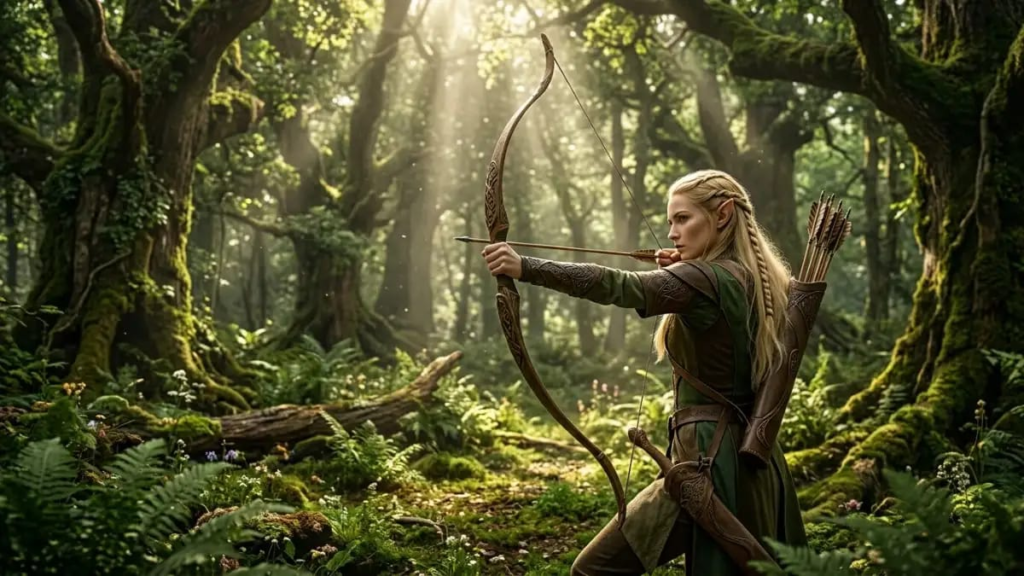
Male Elf Names
Male names often sound calm and noble, with a touch of strength. Here are some famous ones and some invented ones that fit the same style.
Famous male elves
- Legolas: Means green leaf in Tolkien’s Sindarin.
- Elrond: Means star-dome, the lord of Rivendell.
- Celeborn: Means silver tree.
- Thalion: A Sindarin word meaning steadfast or strong.
- Thranduil: The elf king of Mirkwood in Tolkien’s world.
Invented male names
| Name | Style meaning (invented) | How to say it |
| Aelorin | Bright song of the woods | AY-lor-in |
| Faelar | Swift as the wind | FAY-lar |
| Eldrin | Elder of the stars | EL-drin |
| Caelith | Keeper of the quiet | KAY-lith |
| Vaeril | Silver blade | VAY-ril |
| Therion | Hunter of the dawn | THEER-ee-on |
| Lorathil | Child of golden light | LOR-a-thil |
| Syldan | Moon watcher | SIL-dan |
The meanings above are made up for fantasy use. They are not real elvish words, so feel free to change them to suit your story.

Female Elf Names
Female names tend to be lyrical and flowing. Many end in a soft vowel or in -wen, -iel or -ara.
Famous female elves
- Arwen: Means noble maiden in Sindarin.
- Galadriel: Means maiden crowned with a radiant garland.
- Elowen: A real Cornish name meaning elm tree, popular for elf characters.
- Titania: The fairy queen from Shakespeare’s A Midsummer Night’s Dream.
Invented female names
| Name | Style meaning (invented) | How to say it |
| Aeliana | Gift of the morning | ay-lee-AH-na |
| Sylvaen | Lady of the forest | sil-VAY-en |
| Faelina | Little flame of the glade | fay-LEE-na |
| Illyria | Song of the silver lake | il-EER-ee-a |
| Naevys | Whisper of the night | NAY-vis |
| Elaris | Star of the evening | el-AR-is |
| Thaleia | Blossom of spring | thay-LAY-a |
| Mirael | Light on still water | MEER-ay-el |
Unisex Elf Names
Many names work for any character. Soft sounds do not belong to one gender, so these picks are flexible.
- Eirian: A Welsh word meaning bright or beautiful.
- Rowan: A tree name linked to protection in old folklore.
- Ashen: Suggests ash wood and quiet strength.
- Lirien: A made-up name that feels like a song.
- Sorrel: A leafy herb name with a gentle sound.
- Wren: A tiny bird name that suits a quick, clever elf.

Wood Elf Names
Wood elves live close to trees, rivers and animals, so their names often point to nature. Short, earthy sounds work well here.
- Alder, Birch and Hazel for tree-linked names
- Fenwick, Brook and Marlow for water and meadow feelings
- Sylas, Tarvyn and Eowyn-style names with a rustic ring
- Leafsong, Mossfoot and Thistlewind as full descriptive names
Wood elf naming can also be built from two words joined together. This gives them a warm, handmade feel.
High Elf Names
High elves are usually shown as proud, wise and ancient. Their names are longer, formal and full of vowels.
- Aerendiel: A long, regal name for a noble.
- Elenwe: Soft and royal in tone.
- Calatheron: A grand name for a lord or mage.
- Valandriel: A graceful name for a queen or priestess.
For a high elf, add a family title as well, such as Aelorin of the Silver Court. The extra detail makes the character feel important.
Dark Elf Names
Dark elves are often written as sharp and mysterious. Their names keep the elegant structure but add harder sounds like v, x, z and k.
- Vorlaith
- Zyrenn
- Kaelthar
- Nyxara
- Vexiel
- Draevyn
The shift in sound is small, but readers notice it at once. Even simple changes to classic names can create a very different mood.

Christmas Elf Names
Christmas elves are cheerful and playful, so their names are short and fun. Most of them are named after sweets, winter things or sparkly objects.
- Jingle, Tinsel and Twinkle
- Nutmeg, Cocoa and Peppermint
- Snowdrop, Holly and Frost
- Pip, Sprout and Bubbles
- Cinnamon, Ginger and Candy
These names are perfect for an elf on the shelf, a school play or a children’s story. They are easy to say and easy to love.
Elf Names in Real Life and Folklore
Some real first names began with elf roots. Ælfræd, the Old English form of Alfred, means elf counsel. Alvin comes from an old name meaning elf friend, and Aubrey is linked to elf ruler.
Oberon, the king of the fairies in Shakespeare, comes from the same Germanic root. This shows how deep names run in our language.
Famous Elves in Books, Films and Games
Many readers first meet elves through stories. Characters like Legolas, Galadriel and Arwen showed how a short, musical name can make an elf feel unforgettable.
Games added their own style as well. Many role-playing games let players pick an elf race and then invent a name, which is why creative spellings are now so common.
When you study these examples, look at the sound more than the spelling. The best names feel smooth in the mouth and easy on the eye, even when they are completely new.
Elf Names Based on Nature
Nature is the heart of every elf story, so nature themes make a great starting point. Pick a theme first, then build the name around it.
| Theme | Root sounds | Example |
| Moon and stars | Sel, Ela, Ael | Selandra, Elaris |
| Trees and leaves | Syl, Lor, Fen | Sylvaen, Lorathil |
| Water and rivers | Mir, Nae, Ill | Mirael, Naevys |
| Fire and light | Fae, Cal, Aur | Faelina, Calindor |
| Wind and sky | Aer, Zeph, Vae | Aerendiel, Vaeril |
Using a clear theme also helps readers remember the character. A reader who sees Mirael will quickly link her to water and calm scenes.
Elf Last Names and Family Names
Many elves in fiction have a second name that shows their family, home or deeds. These names are often two simple words joined together.
- Moonwhisper: For a quiet, thoughtful family.
- Silverleaf: A classic choice for a woodland house.
- Starweaver: Suits a family of mages or scholars.
- Dawnstrider: Fits a clan of scouts and travelers.
- Nightbloom: Works well for a mysterious or secret line.
- Brightwater: A gentle name for river elves.
You can also use a title instead of a surname, such as of the Silver Court or Keeper of the Glade. This feels natural in a fantasy setting and adds history to your character.
How Long Should an Elf Name Be?
Most strong elf names have two to four syllables. Two syllables feel quick and friendly, while four syllables feel formal and noble.
A good rule is to match the length to the role. A scout or a child can have a short name like Wren or Sylas, while a king or a queen suits something longer like Valandriel.
Always test a name by reading a full sentence with it. If the name slows the sentence down too much, shorten it or add a nickname.
Pronunciation Tips for Elvish Spellings
Fantasy spellings can look hard, but a few habits make them easy. In most English fantasy writing, ae sounds like AY, ei sounds like AY or EE, and th is soft as in thin.
The letter c is usually hard, so Caelith starts with a K sound. If your readers may struggle, add a simple pronunciation note in the first chapter or in a name guide.

How to Create Your Own Elf Names
Making names is easy once you know the pattern. Follow these steps and you can build a new one in minutes.
- Pick a base sound: Start with a soft root such as Ael, Syl, Fae, Thal or Eld.
- Add a middle part: Use a sound like -or-, -ar-, -en- or -ith- to give rhythm.
- Choose an ending: Try -iel, -wen, -las, -dil, -ion or -ara.
- Say it aloud: Make sure it flows and that readers can pronounce it.
- Give it a meaning: Even a made-up meaning helps the name feel real.
- Check for clashes: Avoid names too close to famous ones, like Legolas or Arwen.
For example, Syl plus -en plus -iel gives Sylenel, and Thal plus -or plus -ion gives Thalorion. Small changes in spelling can make both names feel unique.
Tips for Using These Names in Stories and Games
A strong name is only the start. How you use it matters just as much.
- Match the name to the culture: A forest clan and a city court should not sound identical.
- Keep names readable: If readers cannot say it, they will skip it.
- Avoid too many apostrophes: One is fine, but three make a name tiring to read.
- Use nicknames: A long formal name can have a short pet form.
- Be consistent: Keep the same sound rules across one elf family or tribe.
If you write a series, create a small list of rules for your names and stick to it. Readers love worlds that feel organized.
Common Mistakes When Choosing Elf Names
The biggest mistake is copying a famous name too closely. Names such as Legolas or Galadriel with one letter changed can look lazy.
Another mistake is making the name too long. Six or seven syllables look impressive on paper but are hard to read in a story.
Finally, do not mix too many styles. A name like Zyx’thalarielle does not feel like any real elf culture, and it will confuse your audience.
Final Thoughts
elf names and fantasy name inspiration
Elf names combine beauty, nature and mystery in just a few syllables. With soft sounds, nature roots and elegant endings, you can create a name that feels ancient and alive at the same time.
Use the lists in this guide as a starting point, then change them until they fit your character. The best names are the ones that sound right when you say them aloud.
FAQs
What are some good elf names?
Aelorin, Faelar, Sylvaen, Elowen and Arwen are all lovely options. They use soft sounds and flowing endings.
What do these names usually end with?
Common endings are -iel, -wen, -las, -dil, -ion and -ara.
How do I make an elf name?
Pick a soft root like Ael or Syl, add a middle sound and finish with an elegant ending. Then say it aloud to check the flow.
What is a good Christmas elf name?
Jingle, Tinsel, Nutmeg, Peppermint and Twinkle are cute and easy to say.
Are elf names real?
Some come from folklore and real languages, like Alfred and Elowen. Many others are invented for fantasy stories.
What is the difference between wood elf and dark elf names?
Wood elf names are earthy and nature-based. Dark elf names use sharper sounds like v, x and k.