
Italian last names are called cognomen, and there are a great many of them. Some are known all over the world, like Rossi and Ferrari. Others belong to a single village or valley and are hard to find outside it.
The most common Italian last names are Rossi, Russo, Ferrari, Esposito and Bianchi, though the exact order changes by source and year. Most Italian last names come from a father’s name, a trade, a nickname, a place or a religious term. This guide explains each type with 50 examples.
You will also find regional patterns, the truth about name changes at Ellis Island, and practical tips for tracing your own family name. Where experts disagree on a meaning, the entry says so.
How Italian Last Names Work
Most Italian last names formed in the Middle Ages. Towns were growing, and a first name was no longer enough to tell people apart. People added a second name that pointed to a father, a job, a look, a place or a nickname. Over time those labels became fixed family names.
The endings tell you a lot. Names ending in -i, such as Rossi or Bianchi, are usually plural and often meant the family of Rosso or Bianco. Names ending in -o or -a, such as Russo or Costa, tend to be more common in the south.
Small endings matter too. Moretti and Orsini carry diminutive sounds, roughly the little dark one and the little bear. The prefixes De, Di and Della mean of or from, so Di Marco points to a descendant of Marco.
One more point confuses many people. In Italy, women normally keep their own surname after marriage. For children, Italy’s Constitutional Court ruled in 2022 that giving only the father’s surname automatically is unconstitutional, so both parents’ surnames are now the default unless the parents agree otherwise.
The Main Types of Italian Last Names Surname
Italian last names surname fall into one of five groups, though some fit more than one.
- Patronymic: taken from a father’s or ancestor’s first name, like De Luca
- Occupational: taken from a trade, like Fabbri
- Descriptive: based on looks, hair or character, like Rossi
- Geographic: based on a region, town or landmark, like Lombardi
- Religious and foundling: linked to saints, church life or abandoned children, like Esposito
Experts often disagree about a single name, so a few entries below give two possible origins. That is normal in surname research and not a sign of a mistake.
Most Common Italian Last Names
Here are 15 Italian last names surnames that appear again and again in top lists and in everyday life.
| Surname | Meaning | Good to know |
| Rossi | From rosso, red | Usually linked to red hair or a ruddy face. Often ranked number one |
| Russo | A southern form of Rossi, or Russian | Sources differ. Very common in the south and Sicily |
| Ferrari | Plural of Ferraro, from ferro, iron | Points to a blacksmith or iron worker |
| Esposito | From Latin expositus, exposed | Historically given to foundlings |
| Bianchi | From bianco, white | Pale skin or white hair |
| Romano | Of Rome, Roman | A place-based name for someone from or linked to Rome |
| Colombo | Dove | Also the Italian form of Columbus, as in Cristoforo Colombo |
| Ricci | Usually linked to riccio, curly | Often tied to curly hair |
| Marino | From Latin Marinus, of the sea | Also used as a first name |
| Greco | Greek, from Latin Graecus | An ethnic name for someone of Greek origin |
| Bruno | Brown | Brown hair or skin. Also a personal name |
| Gallo | Rooster | Often explained as a nickname for a proud or lively man |
| Conti | Counts, or from the name Conte | Possibly a servant of a count, or a nickname for someone grand |
| De Luca | Son of Luca | A patronymic from the Italian form of Luke |
| Mancini | From mancino, left-handed | A nickname for a left-handed person |
Rossi is usually named as the most common Italian last names surname, with Russo, Ferrari, Esposito and Bianchi regularly close behind. Rankings shift between sources and years, so use them as a rough guide.
Russo shows how sources disagree. Many treat it as a southern variant of Rossi, while others link it to the word for Russian. Both explanations appear in surname references.
Surnames From Trades and Jobs
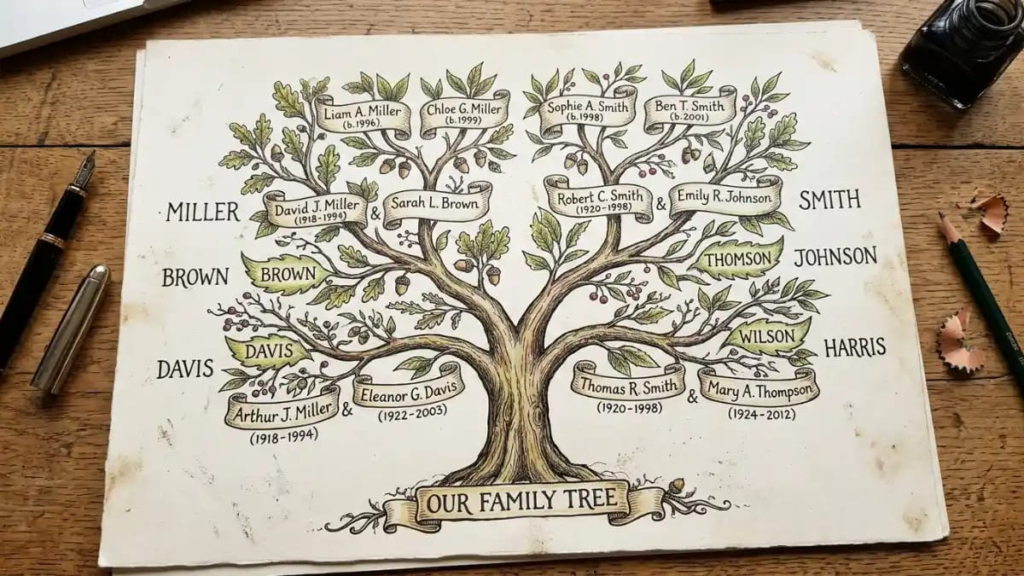
Trade Italian last names show what a medieval town needed: iron, haircuts, clothes, food and flour. Ferrari and Fabbri both point to smiths, which hints at how common metalwork was.
| Surname | Meaning | Good to know |
| Barbieri | Barbers | Plural of barbiere |
| Fabbri | Smiths | Plural of fabbro. Related in meaning to Ferrari |
| Sartori | Tailors | From sarto, tailor |
| Pastore | Shepherd | A direct word for the job |
| Molinari | Millers | From mulino, mill |
Surnames From Looks and Nicknames
Nicknames were an easy way to tell two men called Giovanni apart. A dark-haired man became Moretti, a curly-haired one Rizzo, and a tall one Longo. Rossi, Bianchi and Bruno also belong in this group.
| Surname | Meaning | Good to know |
| Moretti | From moro, dark | Dark hair or skin, with a diminutive ending |
| Rizzo | Curly | Common in the south and Sicily |
| Longo | Long or tall | From lungo |
| Basso | Low or short | A nickname for a short person |
| Grassi | Fat or stout | From grasso. Not always unkind, since a stout person could be seen as well fed |
| Biondi | Blond | From biondo |
Surnames From Places
A place-based surname often shows where a family came from, not where it lives now. A man named Lombardi who moved to Naples was labelled by the place he left.
| Surname | Meaning | Good to know |
| Lombardi | From Lombardy | One of many plural surnames built from place names |
| Fontana | Fountain or spring | Could be a person who lived near a well or fountain |
| Costa | Coast, slope or hillside | The meaning depends on the landscape near the family home |
| Ferrara | The city of Ferrara, or linked to iron | Two origins are possible. Especially common in the south |
| Siciliano | From Sicily | A label for someone who came from the island |
| Toscano | From Tuscany | A label for someone from Tuscany |
Surnames From Fathers’ Names
Patronymics are the most direct type. They say whose child you are. Look for the prefixes De, Di and D’, which all mean of.
| Surname | Meaning | Good to know |
| Di Marco | Of Marco | Descendant of a man named Marco |
| Di Stefano | Of Stefano | From the Italian form of Stephen |
| Di Giovanni | Of Giovanni | From the Italian form of John |
| De Filippo | Of Filippo | From the Italian form of Philip |
| Giordano | From the personal name Giordano | The Italian form of Jordan |
| De Angelis | Of the angels, or from Angelo | Sources differ on which is the main origin |
Spelling can change the look of these names without changing the meaning. Di Marco, DiMarco and De Marco may all point to the same family root, which matters if you search records.
Religious and Foundling Names
Some Italian last names surnames came from church life. Others were given to children left at churches or hospitals, and institutions often handed out standard names.
| Surname | Meaning | Good to know |
| Santoro | Often linked to santo, saint | Some sources trace it to a medieval personal name instead |
| Pellegrini | Pilgrims | Linked to travel to holy places |
| Proietti | Thrown out, from Latin proiectus | Historically linked to foundlings |
| Innocenti | Innocent | Linked to foundling care in Florence |
These names carry a heavy history, but today they are ordinary family names with no stigma. For genealogists, they can be a useful clue to church or hospital records.
Animal Names and More Surnames Worth Knowing
Animals appear as nicknames for traits people admired or joked about. A wolf could be a fierce man, and a fox a clever one.
| Surname | Meaning | Good to know |
| Lupo | Wolf | A nickname for a fierce or cunning person |
| Leone | Lion | Strength or courage |
| Volpe | Fox | A clever or sly person |
| Orsini | Little bear | A noble Roman family carried this name |
| Rinaldi | From the personal name Rinaldo | Of Germanic origin |
| Vitale | Vital, from Latin vitalis | Linked to life and health |
| Serra | Ridge or hill | Also means saw in Italian. Common in Sardinia |
| D’Amico | Of the friend | From amico, friend |
Regional Patterns Across Italy
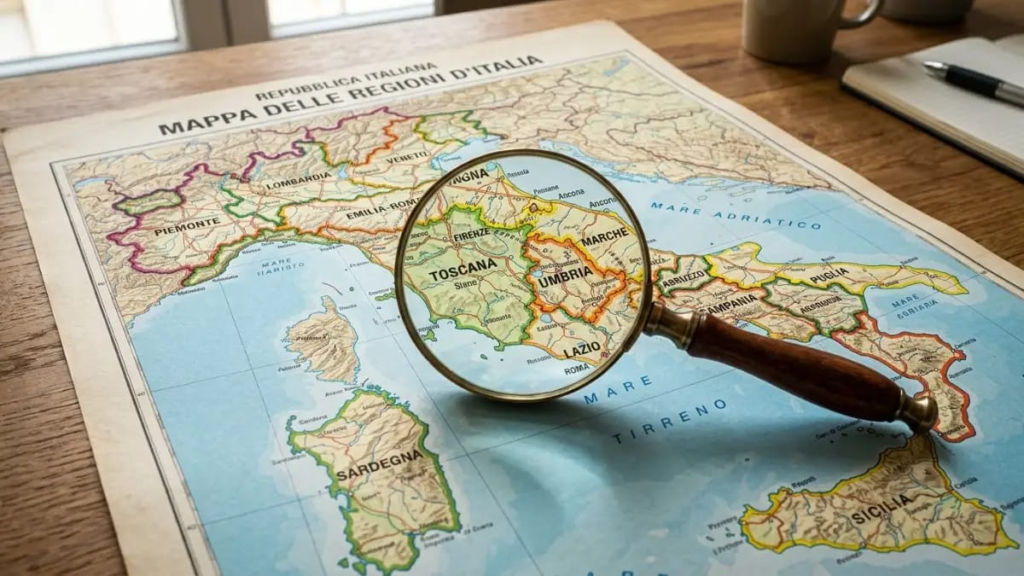
Northern Italy
Plural endings in -i are very common. Surnames built from place names, such as Lombardi, follow a pattern long linked with the Lombard region.
Central Italy
Surnames tied to Rome and Tuscany, such as Romano and Toscano, sometimes mark people who left those areas instead of people who stayed. A place name often shows where a family came from, not where it lives.
Southern Italy and the Islands
Russo is very common in the south and Sicily, and Esposito is often linked with Naples and Campania. The south and Sicily also show Greek, Arab and Norman influence from the past, which is why a name like Greco appears so often.
So an Italian surname can hint at a region, but it does not prove one. Always confirm a family link with records.
Italian Last Names in the United States
Many Americans Italian last names trace their roots to people who emigrated in large numbers between the late 1800s and the early 1900s. Their surnames travelled with them and sometimes changed along the way.
A common story says officials at Ellis Island changed Italian names. Historians generally say this did not happen, because staff worked from ship lists created at the port of departure. Spelling changes more often came later, when families simplified or Anglicised their names, or when records were copied between languages.
That is why you may find Di Marco recorded as DiMarco or Demarco. For searching, try every variant.
How to Trace Your Italian Last Names
Italian last names gives you a clue, not an answer. The records tell the real story. Here is a simple path to follow.
- Start with what you know: ask relatives for full names, birth years and any town names
- Find the comune, the Italian town or municipality of origin, because most records are filed by town
- Look for civil and church records: civil registration began in the 1800s in many areas, with start dates that vary by region, and parish books often go back further
- Search spelling variants, such as Di Marco and DiMarco, or Ferrari and Ferraro
- Check state archive portals such as Portale Antenati, which hosts digitised records, and confirm what it currently covers
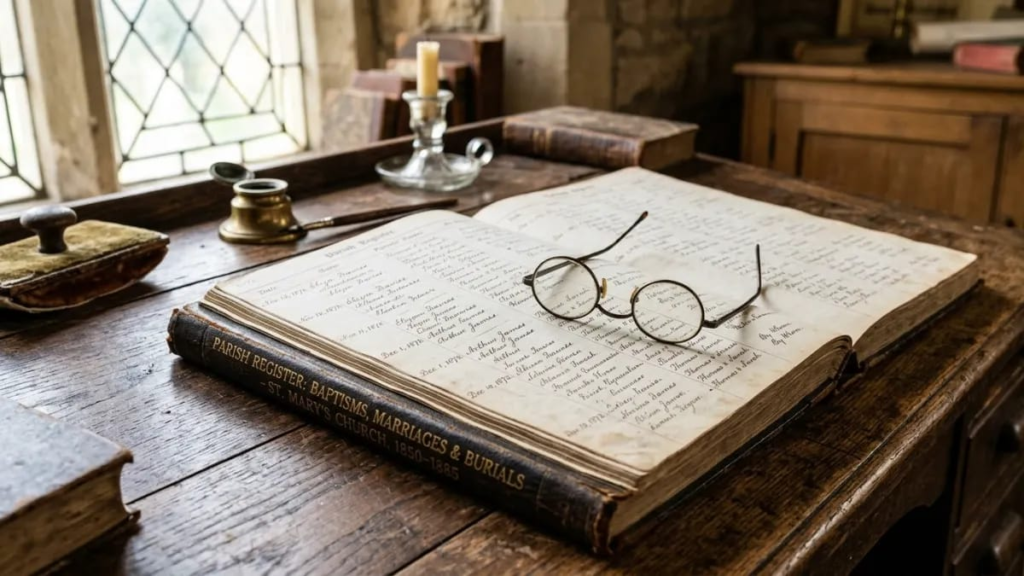
Be patient with handwriting and Latin in older books. Names were sometimes written the way a clerk heard them, so one family can appear under two or three spellings.
Italian Surnames for Characters and Stories
Writers and gamers often search for Italian last names surnames to give characters a believable background. Pick the name to fit the character’s region and story, not just the sound.
- Marco Bianchi: an everyday northern name that suits a normal city life
- Giulia Fontana: soft, simple and easy to read
- Luca Moretti: a classic pairing that sounds natural in many settings
- Elena Greco: a good fit for a southern or Sicilian character
- Paolo Ferraro: a trade name with a solid, working-family feel
Avoid reaching for the same dramatic surnames every time, especially in crime stories. Most Italian families are ordinary, and a normal name makes a character feel more real. [Internal link: Italian first names]
Final Thoughts
Italian last names are small histories. One name can tell you about a father, a trade, a hair colour, a hometown or a saint’s day, all in a few letters.
If you are tracing your own family, use the meanings here as clues and the records as proof. If you are choosing a name for a story, match it to the region. Either way, the endings, prefixes and spellings are worth learning.
FAQs
What is the most common Italian last names?
Rossi is usually listed first Italian last names followed by Russo, Ferrari, Esposito and Bianchi. The exact order differs by source and year.
What do most Italian last names mean?
They mostly come from a father’s name, a trade, a nickname, a place or a religious term. Rossi means red, Ferrari means smith and Romano means from Rome.
What do De and Di mean in Italian surnames?
Both mean of or from. De Luca means of Luca, and Di Marco means of Marco.
Do all Italian last names end in a vowel?
Nearly all do, usually in i, o, a or e. Rare exceptions often come from other languages.
Do Italian women change their surname after marriage?
Normally no. Women in Italy usually keep their own surname.
Were Italian names changed at Ellis Island?
Historians generally say no. Most spelling changes happened later, when families or record keepers adapted the names.
What is the difference between Ferrari and Ferraro?
Ferrari is the plural form and Ferraro is the singular. Both come from the word for iron and point to a smith.