

Indian names are rarely chosen for sound alone. Most carry a meaning from Sanskrit, Persian, Arabic or a regional language, and families often pick them as a blessing, a link to a deity, or a quality they hope the child will grow into.
This guide lists 40 names with meanings, sorted by theme. It then explains how naming customs differ by region and religion, what surnames show, and how to choose a name that works at home and abroad.
Meanings follow the most widely accepted explanations. Where sources differ, the text says so.
Indian Names in Brief
Indian names are given names and family names used across India’s many religions, languages and regions. Most are chosen for their meaning, often from Sanskrit, Arabic, Persian or a regional language. Hindu, Muslim, Sikh and Christian families follow different customs, and surnames can reflect community, family, trade or village.
India has no single naming system. A name that looks complete in one state can look unfinished in another, which is why a little background helps before you pick or interpret a name.
Why Meaning Matters So Much in Indian Names
In many families, the meaning is the whole point. Ananya, which means unique, and Aarav, often explained as peaceful, tell the child and everyone else what the family wishes for.
Hindu families often consult an astrologer, who may suggest a starting syllable based on the child’s horoscope or birth star. The family then chooses a name that begins with that sound.
Names also cross languages. Sanskrit supplies many Hindu names, Arabic and Persian supply many Muslim names, and a few, such as Kabir, are shared across traditions. Because of this mix, the same sound can carry different meanings in different languages.
Meanings can also have more than one layer. Siddharth, for example, is a plain phrase meaning one who has achieved a goal, and it is also the birth name of the Buddha, so the name carries a story as well as a definition.
Language Families Behind the Names
India’s languages fall into several families, and each leaves a mark on names. Hindi, Bengali, Marathi and Gujarati belong to the Indo-Aryan family, and their names lean heavily on Sanskrit.
Tamil, Telugu, Kannada and Malayalam belong to the Dravidian family. They have names from their own languages and also borrow many Sanskrit names, so both layers often appear side by side.
In the Northeast, tribal communities have their own languages and naming traditions, and many of those names do not follow the patterns in this guide. Treat any general rule about the country as a starting point, not a final answer.
Indian Names for Boys With Meanings
These ten boy names are widely used in India and in the Indian diaspora. Each has a short meaning and a note on where you may have heard it.

| Name | Meaning | Note |
| Aarav | Peaceful, calm | Also spelled Arav |
| Arjun | Bright, shining | Warrior hero of the Mahabharata |
| Vihaan | Dawn, a new beginning | Sanskrit-based modern name |
| Aditya | The sun | Linked to the sun deity |
| Rohan | Ascending, rising | Sanskrit root |
| Ishaan | Lord, ruler | A name of Shiva |
| Kabir | Great | Arabic word; also a 15th-century poet-saint |
| Rahul | Capable | Name of the Buddha’s son |
| Siddharth | One who has achieved a goal | The Buddha’s birth name was Siddhartha |
| Dev | God, divine | Often part of longer names |
Several of these names come from epics and sacred stories. That link gives them a familiar feel in most Indian households, even when the family is not especially religious.
Indian Names for Girls With Meanings
Girl names often point to light, learning, devotion or beauty. These ten are common choices.
| Name | Meaning | Note |
| Ananya | Unique, without equal | Sanskrit |
| Diya | Lamp | Linked to the lamps lit at Diwali |
| Aadhya | The first, the beginning | Sanskrit |
| Saanvi | A name of goddess Lakshmi | Also linked to knowledge |
| Priya | Beloved | Often found inside longer names |
| Kavya | Poetry | From the Sanskrit word for poem |
| Meera | Devotee of Krishna | Linked to the poet-saint Mirabai |
| Anjali | Offering | Also the folded-hands gesture |
| Neha | Love, affection | Common across Hindi-speaking regions |
| Pooja | Worship | Named after the Hindu ritual |
Unlike many Western names, most Hindu given names show gender clearly. Sikh names work differently, as the next section explains.
Gender-Neutral Names and the Sikh Naming System
A Sikh given name is usually gender-neutral, and a suffix marks gender. Men use Singh, meaning lion, and women use Kaur, meaning princess. Harpreet Singh is a man, while Harpreet Kaur is a woma

Guru Gobind Singh introduced Singh and Kaur in 1699 to promote equality and move away from caste labels. Many Sikhs later adopted a clan or caste name as a surname and kept Singh or Kaur as a middle name.
- Harpreet: love of God
- Gurpreet: love of the Guru
- Simran: remembrance, usually of God
- Amrit: nectar, linked to the Sikh initiation ceremony
At a Sikh naming ceremony in a gurdwara, the Guru Granth Sahib is opened and the first letter of the verse guides the choice of name. That is why many Sikh names start with the same few sounds, such as Har, Gur and Man.
Outside Sikh tradition, truly gender-neutral choices are rarer. Kiran, meaning ray of light, is one name used for both men and women across India, though most other given names lean clearly one way.
Indian Names Inspired by Hindu Deities
Deity names are among the oldest in India. One reason families choose them is that calling the child keeps the deity’s name in daily speech.
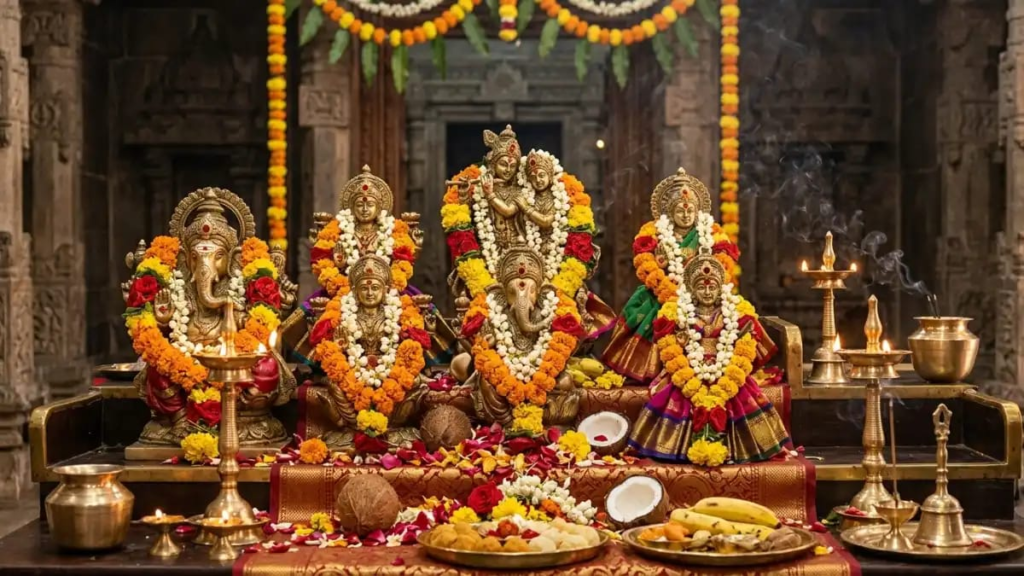
- Krishna: dark, the name of a major Hindu deity
- Lakshmi: goddess of wealth and good fortune
- Ganesh: lord of the ganas, the elephant-headed god
- Durga: the goddess often described as invincible
- Shiva: auspicious, one of the principal Hindu deities
- Saraswati: goddess of knowledge and the arts
Some families add a prefix or suffix to a deity name to make it more personal, so Krishna can become Krishnan or Radhakrishna. This is one of the quickest ways to see how Indian names grow from a shared root.
Nature-Inspired Indian Names
Nature gives names that are short, easy to say and easy to remember. These work well for families who want a meaning without a religious link.
- Surya: the sun
- Chandra: the moon
- Tara: star
- Kamal: lotus
- Megha: cloud
- Sagar: ocean
The lotus holds special weight in Indian culture, which is why Kamal and its relatives appear so often across languages.
Muslim Names in India
Muslim families in India usually choose Arabic names, often with Persian influence. Many honor Quranic figures, family elders or qualities such as kindness and faith.
- Farhan: joyful, happy
- Amina: trustworthy, faithful
- Zoya: alive, full of life
- Sana: brilliance, radiance
Many Muslim families hold an aqiqah ceremony about seven days after birth, when the baby’s name is formally announced. Customs vary by community and region.
Christian and Goan Names
Christian communities in India use biblical and Western names such as Thomas and Mary, often next to local-language names. This is common in Kerala, Goa and parts of the Northeast.
In Goa, many Catholic families carry surnames of Portuguese origin, such as D’Souza and Fernandes. These surnames sit comfortably next to local given names, which shows how history shapes Indian names beyond religion.
Compound Indian Names and Common Name Parts
Many Indian names are built from smaller parts, and spotting those parts makes the names easier to read. Devansh, for example, combines dev, meaning god, with ansh, meaning part, and is usually explained as a part of God.
A handful of words appear again and again as endings or middle names. Learning them makes meanings easy to guess, even for names you have never met.
- Kumar: young man or prince, often used as a middle name or ending
- Devi: goddess, often used by women as part of a name
- Raj: king or rule, seen in names such as Rajkumar, meaning prince
- Nath: lord or protector
- Chand: moon
In daily life these long names are often shortened. Devansh may become Dev at home, and the full form is kept for school, work and official papers.
How Indian Names Differ by Region
In much of northern India, a person has a given name followed by a surname, much like the pattern in English. Punjab adds the Singh and Kaur system described above.
In southern India, people often place the father’s name or the village name as initials before the given name. The cricketer R. Ashwin is an example, where R stands for his father’s name, Ravichandran. These initials are not a first name, and they can confuse forms that expect a surname.
In Maharashtra, the common pattern is a given name, the father’s name and then the family name, as in Sachin Ramesh Tendulkar or Mohandas Karamchand Gandhi. In Bengal, many people have a formal name and a pet name used at home, called a daak naam.
People from the south often adopt a surname when they travel or migrate, simply because forms abroad require one. This is a practical choice and not always part of the family’s tradition.
What Indian Surnames Show
Many surnames in India reflect community, family, caste or village of origin. Some cultural guides add that surnames became widespread during British rule, so the habit is newer than many people expect.
- Patel: linked to a village headman or landholder
- Reddy: a Telugu landholding community
- Nair: a community in Kerala
- Das: servant or devotee
- Khan: a Persian and Turkic title meaning ruler
- Singh: lion
- Kaur: princess
The suffix walla loosely means the trade one’s ancestors practised. Chaiwalla, for example, roughly means a person who makes tea.
Some families deliberately avoid community surnames. A surname alone therefore tells you less than people sometimes assume.
Titles and Honorifics Used With Indian Names
Indian names often appear with respect markers. Cultural guides note that these titles may come as prefixes, suffixes or replacements for the name itself.
- Shri: Mr or sir, placed before a man’s name
- Smt.: short for Shrimati, used for a married woman
- Ji: a respectful ending, as in Rahul ji
- Bhai: brother, added after a man’s name
- Didi: elder sister, added after a woman’s name
- Sahib: a respectful title used with a man’s name
These markers do not change the name. They show relationship or respect, and using them correctly can matter more than the name itself in a formal or family setting.
How Babies Get Their Indian Names: Naming Ceremonies
Hindu families often hold a naming ceremony called namakarana, typically on the eleventh or twelfth day after birth. The date and rules differ by family and region.
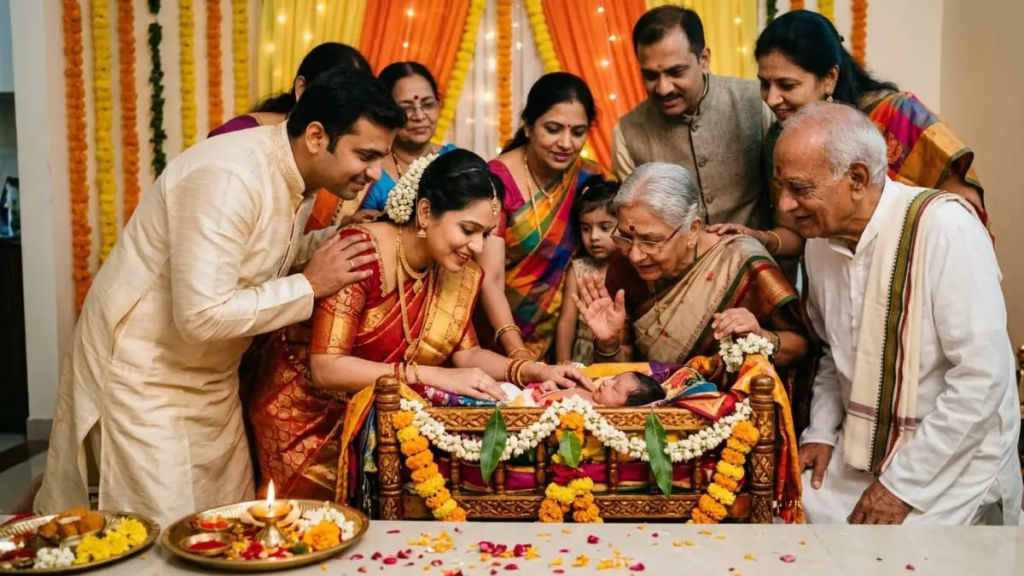
Many families also check which sounds suit the child’s birth star. They look up the sounds linked to that star and then choose a name that starts with one of them. The result is often a short list that the family discusses with elders.
Sikh families hold Naam Karan in a gurdwara, and Muslim families hold aqiqah about a week after birth. Each ceremony ties the name to prayer, family and community, so the choice rarely feels casual.
How to Choose Indian Names That Work Abroad
A name that sounds smooth at home may be mispronounced overseas. A few checks before you decide can save years of correction.
- Say the full name aloud with the surname
- Check common spelling variants, such as Aarav and Arav
- Compare the meaning in two reliable sources
- Think about nicknames the name may produce
- Watch for sounds like dh and bh that English speakers often flatten
- Ask older relatives about family traditions before you settle
Also check what the initials spell. Initials show up on exam papers, email addresses and luggage tags, so an awkward combination can follow a child for years.
A short name with a clear meaning often travels best, but the right choice is the one the family feels proud to explain.
How to Pronounce Indian Names
Pronunciation is the most common stumbling block with names from India. Most names become easy once you know a few sound habits.
- Aspirated sounds such as bh, dh, kh and gh are single sounds with a puff of air, so Dhruv is not Duh-ruv
- Doubled vowels such as aa are held a little longer, so Aarav starts with a long a
- Each vowel keeps one steady sound, so Rohan is Ro-han and not Row-hen
- The final a in names like Priya and Kavya is soft and short
When you are unsure, ask the person to say their name once and repeat it back. Most people welcome that far more than a confident guess.
Spelling and Transliteration Tips
Indian languages use scripts such as Devanagari, Tamil and Bengali, so Roman spellings are transliterations. This is why you see Shiva and Siva, or Kavya and Kaavya, for the same name.
Pick one spelling and use it everywhere, starting with official documents. Matching your passport avoids problems with bank accounts, visas and school records. Using the same spelling for email and social media also helps friends and employers find you.
Quick Picks: Match Indian Names to a Theme
If you want a shortcut, start with the quality you want the name to carry. Then pick from the lists above.
- Devotion: Meera, Krishna, Pooja
- Light and sky: Diya, Surya, Aditya, Tara
- Strength and courage: Arjun, Dev
- Learning and art: Kavya, Saraswati
- Calm and peace: Aarav, Vihaan
- Gender-neutral: Harpreet, Gurpreet, Kiran
Short lists like this help families narrow down a long set of Indian names quickly, and they make it easier to ask relatives for opinions.
Common Mistakes With Indian Names
- Assuming all Indian names are Hindu or Sanskrit
- Assuming every person has a surname
- Treating South Indian initials as a first name
- Guessing a person’s religion or region from a name alone
- Shortening a name without asking the person
- Trusting a single website for a meaning
Avoiding these slips helps you read and write Indian names respectfully and accurately.
Final Thoughts
Indian Name Origins and Meanings
Indian names reward a little curiosity. A short name can hold a deity, a season, a blessing or a family tradition, and the pattern around it changes from one region to the next.
Use the lists above as a starting point, then check any meaning against more than one reliable source. Ask the family when you can, because they usually know the story best.
FAQs
What are some popular Indian names?
Aarav, Arjun, Vihaan, Ananya, Diya and Saanvi are widely used. All six have clear meanings in Sanskrit.
What do Indian names usually mean?
Most carry a meaning linked to a deity, nature, a virtue or a blessing. Many come from Sanskrit, Arabic or Persian.
Do all Indian people have surnames?
No. Some people use initials, a father’s name or a village name instead, especially in southern India.
Why do Sikh names use Singh and Kaur?
Guru Gobind Singh introduced them in 1699 to promote equality. Singh means lion and Kaur means princess.
What is a daak naam?
It is a pet name used at home, common in Bengali families. A formal name is used on documents.
How are South Indian names different?
They often start with initials for the father’s name or village, followed by the given name.
When is the Hindu naming ceremony held?
It is typically held on the eleventh or twelfth day after birth, though practice varies.


