

Irish last names are some of the oldest family names in Europe. Many are over a thousand years old, and they still hold clues about where a family lived, who its ancestors were, and even what they looked like.
If your surname is Murphy, Kelly, or O’Sullivan, you probably have a hunch about where it comes from. This guide goes a step further. You will see what the Gaelic originals mean, why so many names changed spelling, and how to start tracing your own line.
One quick note before we start. Surname meanings are often debated, and spellings shifted a lot over the centuries. Treat each explanation as the most likely story, not a certainty, and check the records when it matters.
Irish Last Names at a Glance
Here are ten very common Irish last names surnames with their Gaelic forms and usual meanings.
- Murphy: from Ó Murchadha, “descendant of the sea warrior”
- Kelly: from Ó Ceallaigh, “descendant of Ceallach”
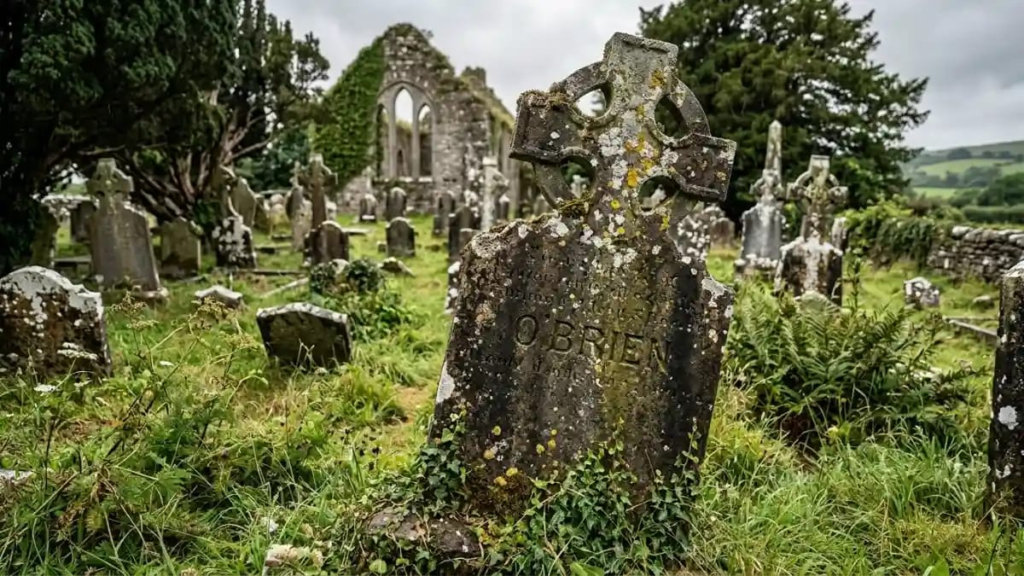
- O’Brien: from Ó Briain, “descendant of Brian”
- Byrne: from Ó Broin, “descendant of Bran,” often read as “raven”
- Ryan: from Ó Riain, with a debated meaning
- Walsh: from Breathnach, “Welshman” or “Briton”
- O’Sullivan: from Ó Súilleabháin, often explained as “hawk-eyed” or “dark-eyed”
- O’Connor: from Ó Conchobhair, “descendant of Conchobhar”
- Doyle: from Ó Dubhghaill, “descendant of the dark foreigner”
- McCarthy: from Mac Cárthaigh, “son of Cárthach”
How Irish last Names Began
Ireland was one of the first countries in Europe to use hereditary Irish last names surnames. The scholar Edward MacLysaght placed the start of that system in the 11th century. Before then, a person was usually known by a first name plus the name of a father or grandfather.
One name, Ó Cléirigh (now O’Clery), is often called one of the oldest recorded surnames in Europe. That shows how far back Gaelic family names reach. Most of the surnames you see today grew out of this early system.
Gaelic names still dominate the picture. They make up roughly two thirds of the surnames recorded in 19th century Ireland, while Anglo-Norman names make up under 10 percent.
Mac, Ó, and Other Prefixes Explained
Early surnames were built by adding a small word in front of an ancestor’s name. The two big ones are Mac and Ó, and they work a little differently.
- Mac (Mc): means “son of.” Mac Cárthaigh is “son of Cárthach,” now McCarthy.
- Ó (O’): means “grandson of” or “descendant of.” Ó Briain became O’Brien.
- Ní and Nic: the female forms. Ní goes with Ó names and Nic goes with Mac names, so a woman might be Mary Ní Bhriain.
- Fitz: from Norman French, meaning “son of.” It arrived after the Norman invasion of 1169, as in Fitzgerald.
- No prefix: some names grew from nicknames and never had one, such as Duff, from dubh, “black.”
Murphy: The Sea Warrior
Origin and Background
Murphy comes from Ó Murchadha and Mac Murchadha, both built on the old name Murchadh, usually explained as “sea warrior.” Several unrelated families took the name in different parts of the country. That helps explain why it became so common.
Where It Stands Today
Murphy has been the most common surname in Ireland for over 100 years, according to the Central Statistics Office. In 2020, 602 babies were registered as Murphy, ahead of 523 registered as Kelly. Famous bearers include actors Cillian Murphy and Eddie Murphy.
Kelly: A Name With Many Theories
Origin and Background of Irish Last Names
Kelly is usually explained as the anglicized form of Ó Ceallaigh, “descendant of Ceallach.” Ceallach was an old chieftain’s name, often translated as “bright-headed,” though the exact meaning is debated.
Where Irish Last Names Stands Today
Kelly sits in second place in Ireland’s rankings and is especially common in counties like Carlow and Tipperary. Some researchers even point to Scottish roots for a few Kelly families. It is a good example of how one name can have more than one origin.
O’Brien: A High King’s Family
Origin and Background
O’Brien comes from Ó Briain, “descendant of Brian.” The Brian in question is Brian Boru, the High King of Ireland who died at the Battle of Clontarf in 1014.
How Irish Last Names Changed
During the anglicization of Ireland, some families dropped the O in official records. That is how forms like Brien and Bryan appeared. Many later restored the original spelling.
Doyle: A Surname With Viking Roots
Origin and Background
Doyle comes from Ó Dubhghaill, “descendant of Dubhghall.” The word literally means “dark foreigner,” a term early Irish writers used for Scandinavian settlers.
Where Irish last names Stands Today
Doyle is one of the top ten surnames in Ireland and is strongest in the south east, in counties like Wexford, Carlow, and Wicklow. It is a handy reminder that Irish surnames record contact with the Vikings, not just Gaelic clans

Byrne: The Raven
Origin and Background
Byrne comes from Ó Broin, “descendant of Bran.” Bran was an 11th century king of Leinster, and his name is often read as “raven.”
Where Irish last names Stands Today
Byrnes are most at home in Wicklow and Dublin. The name ranked third on the first Central Statistics Office list in 2014, with 552 births that year.
Walsh: The Welshman
Origin and Background
Walsh comes from Breathnach, which means “British” or “Welsh.” It was a nickname for Welsh-speaking soldiers who arrived with the Normans in the 12th century.
Spelling Variants
Welsh and Walshe are the two most common alternate spellings. Walsh is one of the most common Norman-linked names in Ireland, yet most families who carry it today think of it as fully Irish.
O’Sullivan: A Munster Clan
Origin and Background
O’Sullivan is the anglicized form of Ó Súilleabháin. Its meaning is argued over, with “hawk-eyed,” “dark-eyed,” and even “one-eyed” all on the table.
Where It Stands Today
The family comes from Munster, mainly Cork and Kerry. Famous bearers include snooker champion Ronnie O’Sullivan and the singer Gilbert O’Sullivan.
O’Neill: Descendants of Niall
Origin and Background
O’Neill comes from Ó Néill, “descendant of Niall.” The Niall in the name is Niall of the Nine Hostages, a semi-legendary High King, and his dynasty became the powerful Uí Néill of Ulster.
Where Irish last names Stands Today
O’Neill ranked 11th on the 2014 Central Statistics Office list. It is one of the best known Irish surnames around the world, and it appears in every list of the most common names.
Gaelic, Norman, Norse, and Scottish Roots
Not every Irish surname is Gaelic in origin. Ireland has absorbed newcomers for a thousand years, and each wave left names behind.
- Gaelic: Murphy, Kelly, O’Brien, and Byrne make up the largest group by far.
- Norse: Doyle and Higgins, the latter from a word meaning “Viking.”
- Norman: Fitzgerald, Burke, Butler, and Barry arrived after 1169.
- Welsh: Walsh means “Welshman” and was given to Welsh-speaking soldiers who came with the Normans.
- Scottish: McDonnell was carried to Ireland by gallowglass warriors from Scotland, who began settling in the 13th century.
- English: Smith is sometimes a plain English name and sometimes a translation of Mac Gabhann, “son of the smith.”
Why the O Disappeared and Came Back
For several centuries, Irish families were pushed toward English-looking names. A law in 1465 told Irish people living in and around Dublin to take English surnames, and clerks often wrote Gaelic names down by sound. The result was plenty of spelling chaos.
Many families dropped Mac or Ó along the way. Ó Conchobhair became Connor or Conner, and Ó Briain became Brien or Bryan. Others translated their names, so a Mac Gabhann might turn into a Smith.
The tide turned in the 1890s, when the Gaelic League pushed a revival of Irish culture and language. Many people put the O back, and the habit grew after independence. Mac came back more slowly, partly because Mac names were already common among Ulster families of Scottish descent.
So if your tree shows “Connor” in 1850 and “O’Connor” in 1950, that is normal. It does not mean you are looking at two different families.
Irish Last Names Surnames by Province
Many surnames still cluster around the area where the original clan lived. Here is a rough guide.
- Munster: O’Sullivan, McCarthy, O’Brien, and Murphy, especially around Cork
- Leinster: Byrne, Doyle, Kavanagh, and Walsh
- Ulster: O’Neill, O’Donnell, Gallagher, and McDonnell
- Connacht: O’Connor, Burke, O’Flaherty, and O’Malley
This is a pattern, not a rule. People moved, and a surname found in Cork today may have started somewhere else.
Spelling Variants to Watch For
One Gaelic name can produce a long list of English forms. Search for all of them.
- Ó Conchobhair: O’Connor, Connor, Conner, Connors
- Ó Súilleabháin: O’Sullivan, Sullivan, Sulivan
- Mac Domhnaill: McDonnell, MacDonnell, McDonald, Donnell
Irish Surnames Around the World
Millions of people left Ireland over the centuries, especially during the Famine years of the late 1840s. They carried their Irish last names surnames to the United States, Canada, Britain, and Australia. Murphy is still among the most common surnames in both the US and Britain.
You may have heard that officials at Ellis Island changed Irish names. That story is mostly a myth. Passenger lists were written at the departure port, and most name changes happened later, when families chose a simpler spelling.
Famous Bearers of Irish Surnames
- Grace Kelly: the American actress who became Princess of Monaco
- John F. Kennedy: the 35th US president, whose great-grandfather left County Wexford
- Cillian Murphy: the Irish actor from Cork
- Ronnie O’Sullivan: the seven-time world snooker champion
Why a Few Surnames Dominate
Ireland has a small number of very common surnames. Part of the reason is that names like Murphy and Kelly began independently in many places, so one name can hide several unrelated families. Another reason is that large clans spread widely and kept their names.
This is why sharing a surname with a famous person rarely proves a family link. Unless you can follow the records, treat the connection as a possibility, not a fact.
Descriptive and Job-Based Surnames
Plenty of surnames began as nicknames or trades. They are often the easiest ones to translate.
- McAteer: from Mac an tSaoir, “son of the craftsman”
- Duff: from dubh, “black,” likely a nickname for dark hair
- Bane: from bán, “white” or “fair”
- Kennedy: from Ó Cinnéide, often explained as “helmet-headed”
Timeline of Irish Last Names
- Before 900: people use a first name plus a father’s or grandfather’s name
- Early 900s: Ó Cléirigh enters the records, one of the earliest surnames in Europe
- 11th century: hereditary surnames become common
- 1014: Brian Boru dies at Clontarf, and his descendants carry the name Ó Briain
- 1169: the Norman invasion brings Fitz names, plus Burke and Butler
- 1465: English law pushes Irish families around Dublin to adopt English surnames
- 1600s: plantations and harsh laws speed up anglicization
- 1890s: the Gaelic League revival leads families to restore O and Mac
- 1920s: after independence, Gaelic forms become more fashionable
Irish Last Names Surname Meanings in Simple Words
- Murphy: sea warrior
- O’Brien: descendant of Brian
- Byrne: raven, or descendant of Bran
- Walsh: Welshman
- Doyle: dark foreigner
- Lynch: seafarer
- McAteer: son of the craftsman
- Duff: black
Does Your Surname Look Irish Last Names?
Some patterns give Irish last names away. None are foolproof, but they are a decent starting point.
- It starts with O’, Mc, Mac, or Fitz.
- It ends in -an, like Brennan, Nolan, or Madigan.
- It ends in -agh or -her, like Kavanagh or Gallagher.
- It is a short nickname-style name with no prefix at all, like Duff or Dunne.
Tips for Tracing Your Irish Last Names Surname
Tracing an Irish last names line is possible, but it takes patience. These steps work well for most people.
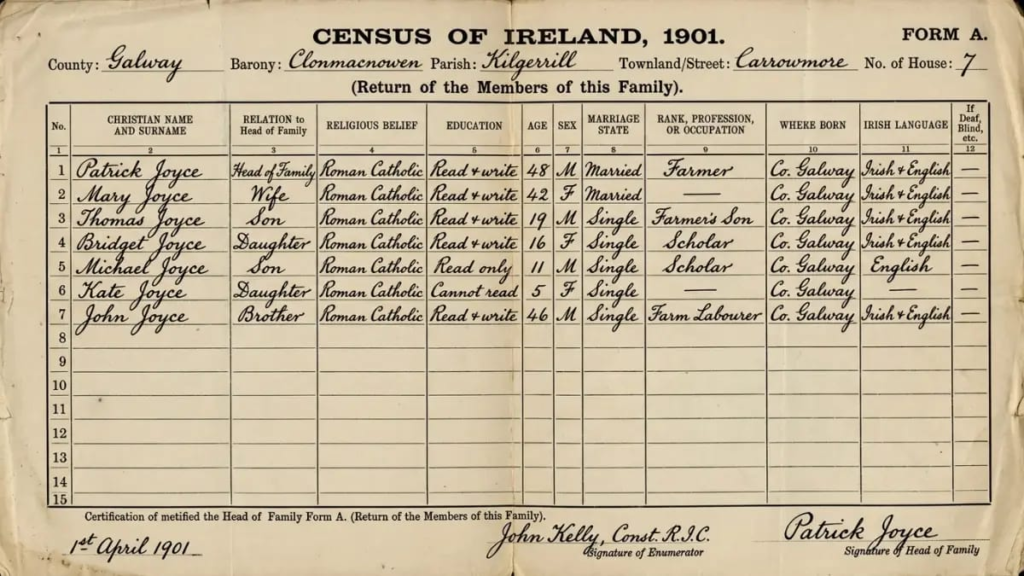
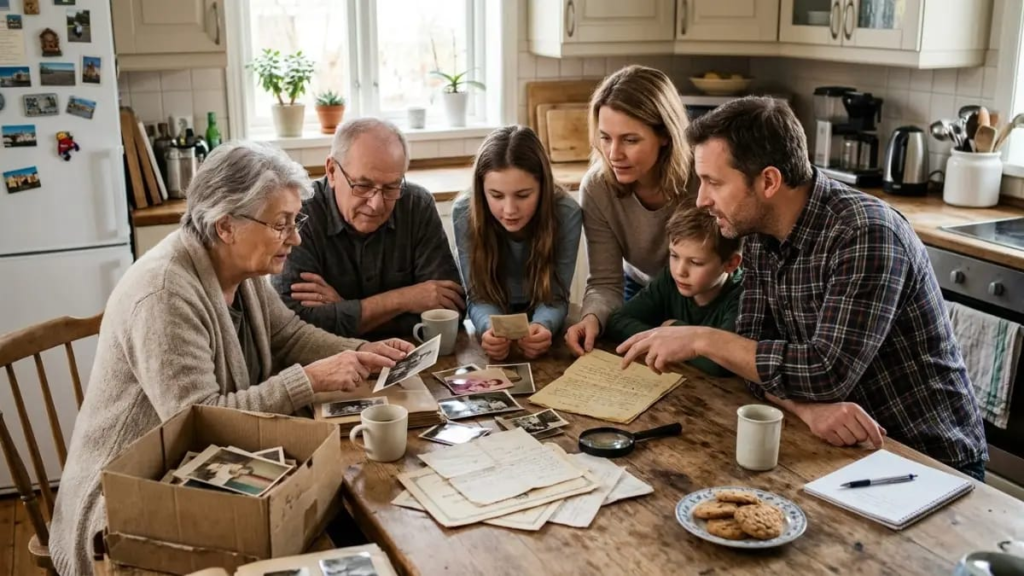
- Start at home. Ask relatives for names, dates, and the townland or parish where your family lived. A townland is Ireland’s smallest land division, and it is one of the best clues you can find.
- Try every spelling. Search for Connor, Conner, and O’Connor. Try each one with and without Mac or Ó.
- Use the 1901 and 1911 censuses. They are free online at the National Archives of Ireland and list every person in each household.
- Check civil records. Civil registration of births, deaths, and marriages began in 1864, and the index is free on IrishGenealogy.ie. Non-Catholic marriages were registered from 1845.
- Look at church registers. The National Library of Ireland offers free scans of most Catholic parish registers, which cover baptisms and marriages before civil records began.
- Search Griffith’s Valuation. This mid-1800s land survey lists heads of household, which helps because most 19th century censuses were lost.
- Consider a DNA test. It can link you with distant cousins and show which branch of a big name you belong to.
Trusted Resources for Irish last Names Surname Research
A few reliable sources will save you hours of guesswork.
- The Surnames of Ireland by Edward MacLysaght, the classic reference on origins and meanings
- John Grenham’s Irish Ancestors: a well-known site with surname maps and record guides
- National Archives of Ireland: free census records for 1901 and 1911
- IrishGenealogy.ie: free civil records and many church registers
Common Mistakes When Researching Irish Last Names Surnames
- Believing every surname has one family crest. Coats of arms were granted to individuals, not to surnames, so a “Murphy crest” on a gift shop mug proves nothing.
- Expecting the O or Mac to be there. Many correct records leave it out.
- Trusting a single spelling. Clerks wrote names by ear.
- Treating a meaning as proof of origin. Several unrelated families can share one surname.
- Stopping at the surname. The townland and parish usually matter more than the name itself.
Final Thoughts
Irish surnames and name origins
Irish last names work like small history lessons. A Murphy carries the sea, a Doyle carries the Vikings, and an O’Brien carries a king.
Names shifted with every conquest and revival, but the core stayed in place. Start with your own spelling, follow the records one step at a time, and you may find the Gaelic original your family lost.
FAQs
What is the most common Irish last names surname?
Murphy. It has held first place for over a century.
What does Mac mean in Irish last names?
It means “son of.” Ó means “grandson of” or “descendant of.”
Is O’Brien different from Brien?
No, it is the same name. The O was dropped or restored over time.
Are Mc and Mac the same Irish last names?
Yes. Mc is a short form of Mac.
Do all Irish surnames start with O or Mac?
No. Names like Kelly, Byrne, and Walsh have no prefix today.
Is Walsh an Irish name?
Yes. It means “Welshman” and came with Norman-era soldiers.


