

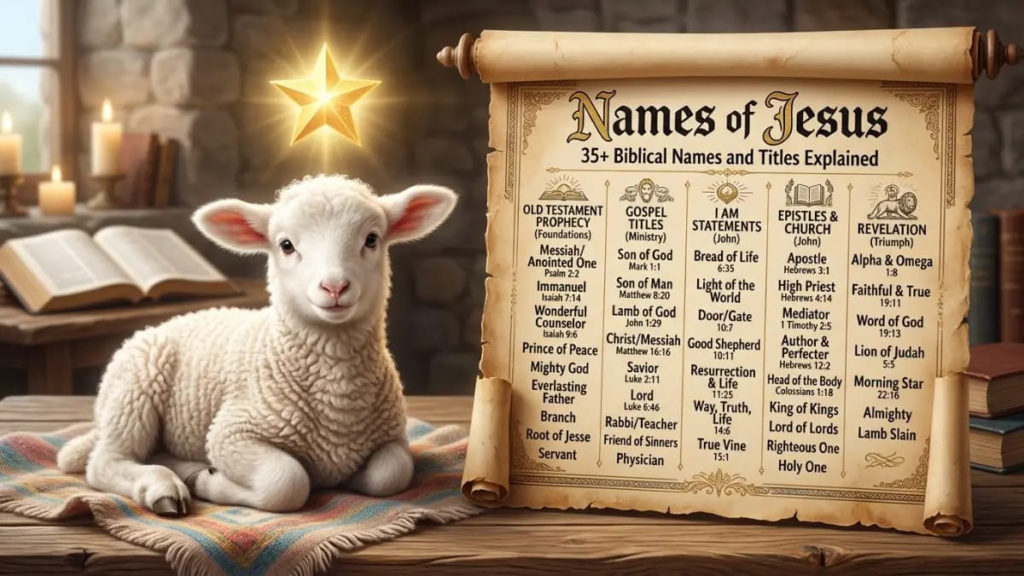
Names of Jesus by dozens of different names, and each one highlights a different side of who he is. Some point to his role as a king, others to his role as a servant, and a few come straight from his own mouth.
This guide gathers the most important names of Jesus into clear categories: Old Testament prophecy, Gospel titles, the “I Am” statements, and the names used in the Epistles and Revelation.
Names of Jesus below includes where it comes from in Scripture, so you can look it up yourself rather than taking it on faith alone.
Some of these titles are household names, like Prince of Peace or Good Shepherd. Others show up only once or twice in the entire Bible, which is part of what makes them worth digging into.
Why Does Jesus Have So Many Names?
In short: Names of Jesus captures a different role or promise, so together they build a fuller picture than any single title could.
A king needs a name that speaks to authority. A shepherd needs a name that speaks to care. Jesus carries both roles at once, along with dozens of others, which is why Scripture uses so many different titles for him.
Old Testament prophets described a coming Messiah centuries before his birth, and the New Testament writers picked up those same titles once Jesus arrived. That overlap is part of why Christians see the two halves of the Bible as one connected story.
There’s also a practical reason for the variety. Different writers were addressing different audiences: Matthew wrote for a Jewish readership familiar with messianic prophecy, while John leaned on Greek philosophical language like “the Word.” The names shift depending on who’s speaking and who’s listening.

Names of Jesus Used for Himself vs. Titles Others Gave Him
It’s worth separating the names of Jesus chose for himself from the ones other people pinned on him, since the two groups reveal slightly different things.
“Son of Man” was Jesus’s own preferred self-description, and he used it constantly, especially when predicting his suffering. It’s a humble title on the surface, though it also carries a strong claim to authority from the Book of Daniel.
Titles like “Son of God,” “Messiah,” and “King of the Jews,” on the other hand, usually came from someone else, whether a disciple, a demon, a Roman soldier, or a crowd. Watching who uses which title, and when, is one of the more rewarding ways to read the Gospels closely.

Names of Jesus in Old Testament Prophecy
These names of Jesus appear hundreds of years before Jesus was born, mostly in the prophetic books. Christians read them as predictions that Jesus later fulfilled.
- Immanuel — means “God with us,” first given as a sign to King Ahaz. (Isaiah 7:14)
- Wonderful Counselor — points to wisdom beyond ordinary human advice. (Isaiah 9:6)
- Mighty God — identifies the coming child with divine power itself. (Isaiah 9:6)
- Everlasting Father — describes an eternal, fatherly care over his people. (Isaiah 9:6)
- Prince of Peace — promises an end to conflict under his reign. (Isaiah 9:6)
- Root of Jesse — ties Jesus to the family line of King David’s father. (Isaiah 11:10)
- The Branch — pictures new growth springing from an old, seemingly dead family tree. (Jeremiah 23:5)
- Star out of Jacob _ an early prophecy pointing toward a future ruler. (Numbers 24:17)
Names and Titles of Jesus in the Gospels
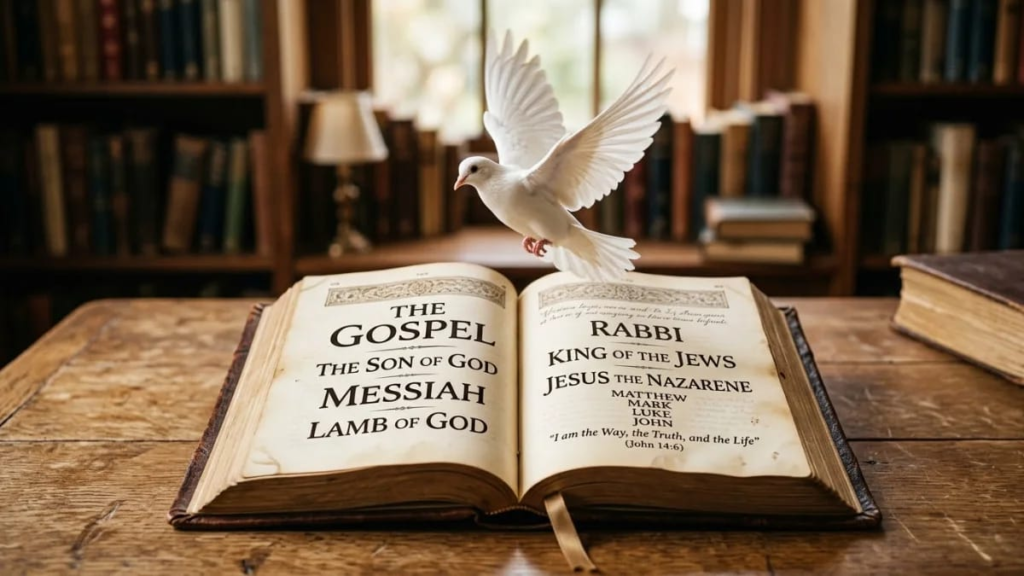
The four Gospels use a wide mix of titles, some given by others and some Jesus used for himself.
- Son of God — affirms his divine identity, most famously in Peter’s confession. (Matthew 16:16)
- Son of Man — Jesus’s own favorite self-description, used roughly 80 times in the Gospels. (Matthew 8:20)
- Messiah (Christ) — means “Anointed One,” the title Israel expected for its promised deliverer. (John 1:41)
- Rabbi — a respectful Jewish title meaning “teacher.” (John 1:38)
- Lamb of God — connects Jesus to the sacrificial system of the Old Testament. (John 1:29)
- King of the Jews — used by the wise men and later, ironically, on his cross. (Matthew 2:2)
- Nazarene — a reference to the town of Nazareth, where Jesus grew up. (Matthew 2:23)

The “I Am” Names of Jesus
In short: Jesus’s seven “I Am” statements in John’s Gospel echo God’s own name from Exodus, so first-century Jewish listeners would have recognized the claim immediately.
Each “I Am” statement pairs a title with a specific promise, which is part of why these names remain some of the most quoted in the New Testament.
- Bread of Life — answers spiritual hunger the way bread answers physical hunger. (John 6:35)
- Light of the World — promises guidance out of spiritual darkness. (John 8:12)
- The Door (Gate) — pictures Jesus as the only entry point to safety. (John 10:9)
- Good Shepherd — describes a leader who protects and even dies for his flock. (John 10:11)
- The Resurrection and the Life — spoken directly before raising Lazarus from the dead. (John 11:25)
- The Way, the Truth, and the Life — answers Thomas’s question about how to reach God. (John 14:6)
- The True Vine — pictures believers as branches drawing life from him. (John 15:1)

Names of Jesus in the New Testament Letters
Names of Jesus are Paul, Peter, and the author of Hebrews all add their own titles once they start explaining what Jesus’s life and death actually accomplished.
- Lord — the most common New Testament title, used to affirm his authority. (Romans 10:9)
- Head of the Church — pictures Jesus directing the church the way a head directs a body. (Ephesians 5:23)
- Firstborn over All Creation — a title about rank and priority, not birth order. (Colossians 1:15)
- Mediator — describes his role standing between God and humanity. (1 Timothy 2:5)
- High Priest — a title borrowed from the temple system, applied to Jesus permanently. (Hebrews 4:14)
- Author and Perfecter of Faith — credits Jesus with both starting and completing the life of faith. (Hebrews 12:2)
- The Last Adam — contrasts Jesus with the first Adam, reversing the effects of the fall. (1 Corinthians 15:45)

Names of Jesus in the Book of Revelation
Revelation’s titles for names of Jesus lean toward power and finality, fitting a book about the end of the story.
- Alpha and Omega — the first and last letters of the Greek alphabet, meaning beginning and end. (Revelation 22:13)
- Lion of the Tribe of Judah — a title of strength and kingship. (Revelation 5:5)
- Root of David — links Jesus to the royal line while placing him above it. (Revelation 22:16)
- King of Kings and Lord of Lords — the highest possible title of authority in Scripture. (Revelation 19:16)
- Faithful and True — describes his unshakable reliability. (Revelation 19:11)
- The Bright Morning Star — a hopeful image announcing the arrival of a new day. (Revelation 22:16)
- The Amen — an unusual title meaning his word is final and trustworthy. (Revelation 3:14)
Lesser-Known Names of Jesus
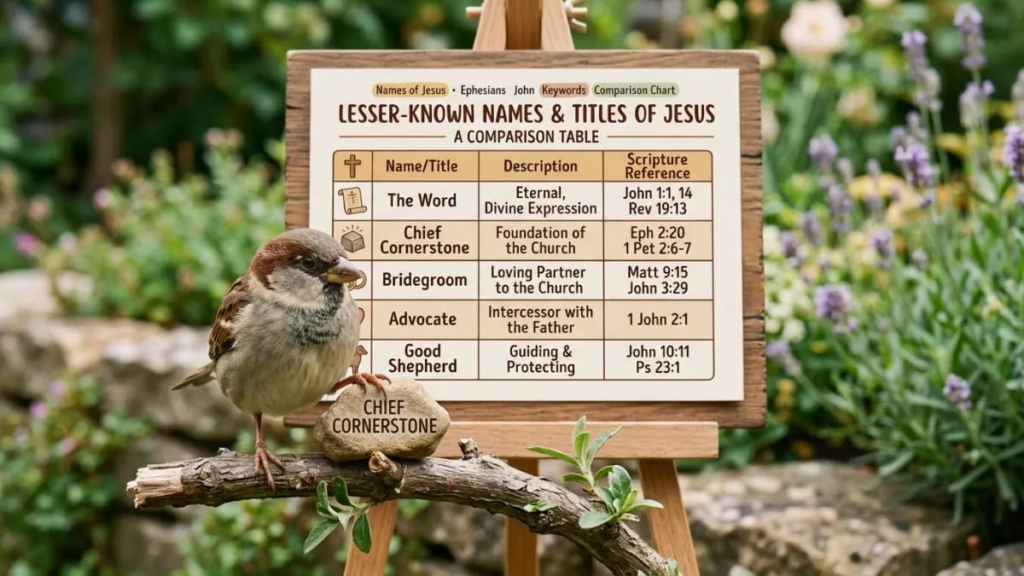
Beyond the famous titles, Scripture uses a handful of names of Jesus that rarely make it onto a Sunday school poster but still carry real weight.
- The Word — identifies Jesus as God’s self-expression, present at creation itself. (John 1:1)
- Chief Cornerstone — pictures Jesus as the foundation piece the rest of the church is built around. (Ephesians 2:20)
- The Bridegroom — an image of intimate, covenant love between Jesus and his followers. (Matthew 9:15)
- Advocate — describes Jesus pleading believers’ case before God, like a defense attorney. (1 John 2:1)
- Apostle and High Priest — a rare double title tying together the ideas of “sent one” and “mediator.” (Hebrews 3:1)
- The Beginning of God’s Creation — describes Jesus’s role as the source and starting point of all things. (Revelation 3:14)
Names of Jesus at a Glance
| Category | Example Names | Where to Find Them |
| Old Testament Prophecy | Immanuel, Wonderful Counselor, Prince of Peace | Isaiah, Jeremiah, Numbers |
| Gospel Titles | Son of God, Messiah, Lamb of God | Matthew, Mark, Luke, John |
| “I Am” Statements | Bread of Life, Good Shepherd, True Vine | Gospel of John |
| Epistle Titles | Head of the Church, Mediator, High Priest | Romans through Hebrews |
| Revelation Titles | Alpha and Omega, King of Kings, Morning Star | Book of Revelation |
How to Use These Names of Jesus in Prayer and Study
In short: Names of Jesus to what you’re actually going through turns a list of titles into a genuinely useful prayer tool.
These names work best when they’re tied to a real situation rather than memorized as trivia. Picking a name that matches what you’re actually facing turns a title into something closer to a promise you’re claiming.

A few starting points:
- Feeling anxious or in conflict? Pray to the Prince of Peace and ask specifically for peace in that situation.
- Facing a decision? Ask the Wonderful Counselor for wisdom before you act, not after.
- Studying a Gospel passage? Note which title is used in that scene and ask why the author chose it.
- Teaching kids or a small group? Assign one name per week and read its Scripture reference together.
- Feeling distant from God? Read one of the seven “I Am” statements slowly, out loud, more than once.
None of this requires special training. Keeping a simple list of names nearby, whether in a journal or a notes app, makes it easier to reach for the right one in the moment instead of defaulting to the same generic prayer every time.
What These Names of Jesus Reveal About Jesus’s Character
Looking at the full list side by side, a pattern starts to emerge. The names split fairly evenly between power and tenderness, which seems to be intentional rather than accidental.
Titles like King of Kings, Mighty God, and Lion of the Tribe of Judah point to strength and authority. Names like Good Shepherd, Lamb of God, and Bread of Life point in the opposite direction, toward gentleness and provision.
Reading only the powerful titles risks picturing a distant, intimidating figure. Reading only the gentle ones risks picturing someone without any real authority. Scripture seems to insist on holding both sets together, which is arguably the whole point of collecting so many names in the first place.

Final Thoughts
No single name fully captures who Jesus is, which is exactly why the Bible uses so many. Reading them together, from Immanuel in Isaiah to the Alpha and Omega in Revelation, tells one continuous story rather than a list of disconnected titles.
Next time you read Scripture, pay attention to which name is being used and why. It often says as much about the moment in the story as it does about Jesus himself.
Whether you’re studying for a sermon, teaching a class, or just reading on your own, treating these names as a connected set rather than isolated trivia tends to deepen the reading a lot faster than skimming for a single favorite verse.
FAQs
How many names of Jesus have in the Bible?
Scholars count over 200 names and titles, though only about 30 to 40 appear regularly across the Gospels and Epistles.
What does the names Jesus actually mean?
Jesus (Yeshua) means “the Lord saves,” a name given by an angel before his birth.
What’s the difference between Jesus and Christ?
Jesus is his given name; Christ means “Anointed One” and describes his role as the promised Messiah.
Why is Jesus called Immanuel?
Immanuel means “God with us,” fulfilling Isaiah’s centuries-old prophecy about God dwelling among his people.
What do the “I Am” statements mean?
They echo God’s own name from Exodus 3:14, so first-century listeners understood Jesus was claiming a divine identity.
Which name of Jesus appears most often?
“Lord” and “Christ” are the most frequently used titles across the New Testament letters.
Can I pray using these names?
Yes — many Christians pick a name that matches their situation, like praying to the “Good Shepherd” when feeling lost or afraid.