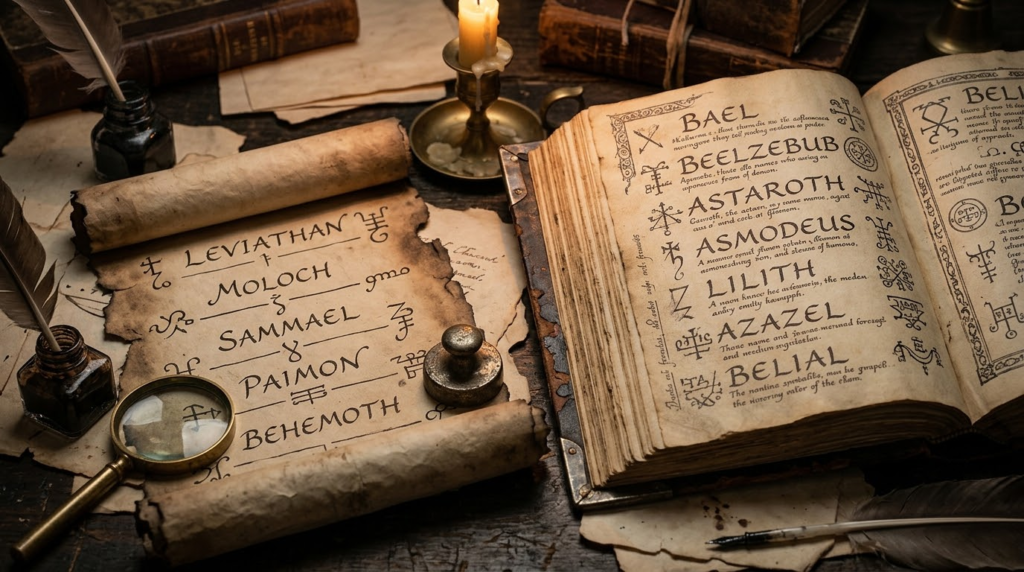

Demon names topics in folklore pull readers in as strongly as the names of dark spirits. Demon names such as Lucifer, Beelzebub, Asmodeus, and Lilith appear in sacred texts, medieval spell books, classic poems, novels, films, and video games. People search for them to write stories, build game characters, study religion, or simply find out where these frightening words came from.
In this guide, you will find famous demon names grouped by source, with their origins, meanings, and the stories that made each one famous. You will also see how these names grew from ancient gods and desert spirits into the villains we know today, how modern media uses them, and how to choose a fitting name for your own fictional character.
The details below draw on the Bible, scholarly work on Mesopotamian religion, and the well-known demonology books of early modern Europe. Beliefs about spirits differ across faiths and eras, so treat this guide as a cultural and historical overview, not as religious teaching or a practical manual of any kind.
Demon Names at a Glance
Here are ten of the best-known demon names, with their sources and meanings.
- Lucifer – Latin for “light-bringer,” from the morning star in Isaiah 14
- Beelzebub – Hebrew, often explained as “lord of the flies,” from the god Baal-zebub
- Asmodeus – from the Book of Tobit, a demon of lust and rage
- Belial – Hebrew for “worthless” or “without value”
- Mammon – Aramaic for wealth, later a demon of greed
- Azazel – linked to a scapegoat ritual and the Book of Enoch
- Lilith – a night spirit from Mesopotamian and Jewish lore
- Mephistopheles – the devil’s clever servant in the German Faust legend
- Pazuzu – Mesopotamian king of the wind demons
- Leviathan – Hebrew sea monster, later tied to envy
Where Demon Names Come From
Most demon names did not appear out of nowhere. Many began as the names of local gods, natural forces, or feared spirits, and later writers recast them as evil beings. The word demon itself comes from the Greek daimon, which first meant a spirit or divine power and was not always bad. Over the centuries, especially in Jewish, Christian, and Islamic writing, the term shifted toward harmful spirits.
Four main streams feed the lists people use today. The first is ancient Mesopotamia, which gave us Lamashtu and Pazuzu. The second is the Hebrew Bible and the New Testament, which gave us Satan, Belial, Azazel, and Beelzebub. The third is the grimoires of the medieval and early modern period, which catalogued dozens of spirits with ranks and titles. The fourth is modern fiction, which keeps inventing new names in the same style.

Lucifer: The Light-Bringer
Origin and Background
Lucifer is Latin for “light-bringer” and was a name for the morning star, the planet Venus seen before sunrise. It appears in the Latin Vulgate translation of Isaiah 14:12, a poem that mocks a fallen Babylonian king. Later Christian writers read the verse as the story of Satan’s fall from heaven, and the poetic title slowly became a personal name for the devil.
Meaning and Inspiration
The meaning is bright, which makes the story ironic: a name about light now stands for rebellion and pride. John Milton’s epic Paradise Lost, published in 1667, gave Lucifer his best-known literary form as a proud and tragic rebel. Modern writers still lean on this image when they want a charming, powerful antagonist.
Beelzebub: Lord of the Flies
Origin and Background
The demon names come from the Hebrew Bible, where 2 Kings 1 mentions Baal-zebub, a god worshipped in the Philistine city of Ekron. The usual explanation is “lord of the flies,” although some scholars think the original form was Baal-zebul, meaning “exalted lord,” and that the fly version was a deliberate insult. In the Gospels, Beelzebub is called the prince of demons.
Meaning and Inspiration
Later demonologists made Beelzebub a high-ranking figure in hell. In a famous 1589 scheme by the German churchman Peter Binsfeld, he became the demon of gluttony. William Golding took the title of his 1954 novel Lord of the Flies from the name’s popular meaning.
Asmodeus: The Demon Names of Lust and Rage
Origin and Background
Asmodeus first appears in the Book of Tobit, a Jewish text written around the third or second century BCE. There he torments a young woman named Sarah until the angel Raphael drives him away. Many scholars connect the name with the Persian spirit of wrath, Aeshma, though the link is debated.
Meaning and Inspiration
In later Jewish tradition, Asmodeus appears as a king of demons in stories about Solomon, and in the Ars Goetia he is a three-headed king. Binsfeld assigned him to lust. Today he is a favorite in games, comics, and television, usually as a sly and powerful ruler.
Lilith: The Night Spirit
Origin and Background
Lilith grew out of the Mesopotamian lilitu, a class of wind and night spirits mentioned in Sumerian and Akkadian texts. A Hebrew word, lilit, appears once in Isaiah 34:14 among the creatures of a ruined land. A medieval text, the Alphabet of Ben Sira, later told of Lilith as Adam’s first wife, who refused to obey him and fled.
Meaning and Inspiration
Popular tradition links the name to layil, the Hebrew word for night, but scholars trace it to the older Mesopotamian term. Today Lilith is also a symbol in feminist writing, a character in fantasy fiction, and a real given name, which shows how a feared name can be reclaimed.
Other Names From the Bible: Belial, Mammon, Azazel, and Abaddon
- Belial is a Hebrew word meaning worthless, used in phrases such as “sons of Belial.” Later texts, including the Dead Sea Scrolls, turned it into a personal name for the leader of darkness.
- Mammon is an Aramaic word for wealth. In the Gospel of Matthew, no one can serve both God and Mammon, and medieval writers turned the word into a demon of greed.
- Azazel appears in Leviticus 16, where a goat is sent into the wilderness for him. The Book of Enoch later made him a fallen angel who taught humans forbidden skills.
- Abaddon is Hebrew for destruction. In Revelation 9:11, the angel of the abyss is called Abaddon in Hebrew and Apollyon, “destroyer,” in Greek.
Demon Names in Medieval and Early Modern Grimoires
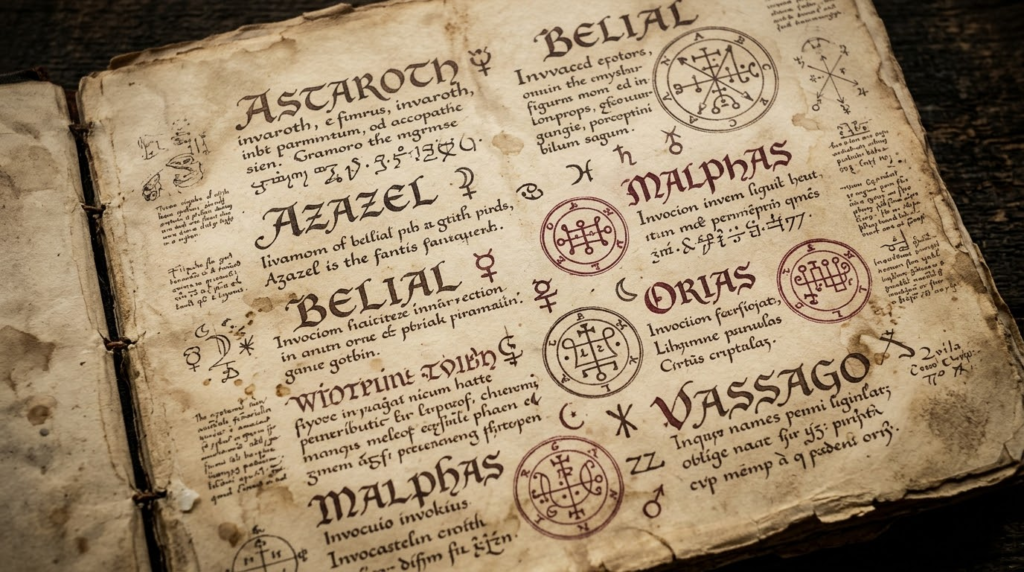
From the sixteenth century, European writers built long catalogues of spirits. Johann Weyer’s Pseudomonarchia Daemonum, printed in 1577, listed 69 demons with ranks, appearances, and powers. The Ars Goetia, part of the Lesser Key of Solomon and dated to the seventeenth century, expanded the list to 72 spirits such as Bael, Paimon, Vassago, and Buer. Collin de Plancy’s Dictionnaire Infernal, first published in 1818, brought these entries to general readers.
Binsfeld’s 1589 list matched seven chief demons to the deadly sins: Lucifer for pride, Mammon for greed, Asmodeus for lust, Leviathan for envy, Beelzebub for gluttony, Satan for wrath, and Belphegor for sloth. These books matter because many fantasy villains and game bosses borrow their names directly from them.
Demon Names Borrowed from Older Gods
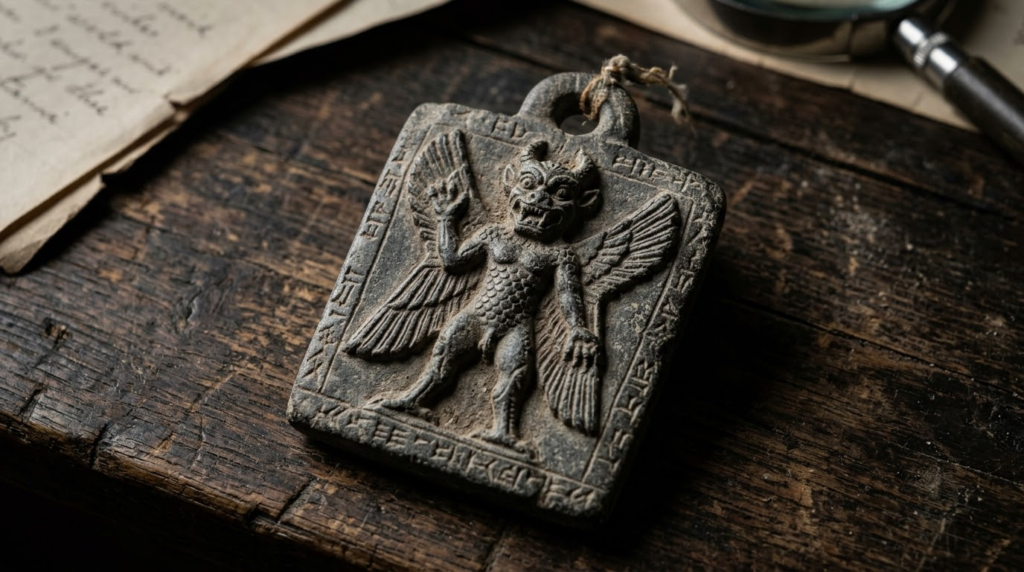
Many grimoire entries were recycled from earlier religions. Bael echoes the Canaanite storm god Baal, Astaroth echoes the goddess Astarte, and Dagon, a god of the Philistines mentioned in the Book of Judges, appears in later lists of fallen spirits. Moloch, condemned in Leviticus, follows the same path. This pattern shows how the gods of a defeated or rival faith often became the monsters of the next one.
Demon Names Around the World
Beyond the Bible and the grimoires, nearly every culture has its own dreaded spirits.
- Pazuzu was a Mesopotamian king of wind demons whose image was worn as protection against other evils. Modern audiences know the name from the 1973 film The Exorcist.
- Lamashtu was a feared Mesopotamian demoness blamed for harming mothers and infants, whom people tried to keep away with amulets.
- Ravana is the ten-headed king of the rakshasas in the Hindu epic the Ramayana.
- Oni are horned, ogre-like demons in Japanese folklore, often shown with iron clubs.
- Iblis is, in Islamic tradition, the proud jinn who refused to bow to Adam. He is also called Shaytan.
Why Demon Names Fascinate Readers and Writers
- They sound powerful. Hard consonants and long vowels, as in Beelzebub or Mephistopheles, feel dramatic when spoken aloud.
- They carry history. Each name links to a real text, a real culture, or a real turning point in religious thought.
- They break everyday naming rules. Nobody expects to meet someone called Abaddon, so the name instantly signals danger.
- The stories are rich. A name like Lilith or Lucifer comes with centuries of retellings that writers can build on.
- Fear and curiosity go together. People enjoy safe encounters with frightening things, and a good name delivers that thrill.
Demon Names in Pop Culture
Literature and Theatre
Dante’s Inferno, completed in the early fourteenth century, filled hell with named devils such as Malacoda and Barbariccia. Goethe’s Faust gave Mephistopheles a new life on stage, and Neil Gaiman and Terry Pratchett’s 1990 novel Good Omens made the demon Crowley a fan favorite.
Film and Television
On screen, The Exorcist made Pazuzu a household name, the series Lucifer, which aired from 2016 to 2021, turned the devil into a charming nightclub owner, and Supernatural named its Yellow-Eyed Demon Azazel.
Video Games and Tabletop Roleplaying
The Diablo series from Blizzard, which began in 1996, features Diablo, Mephisto, and Baal as the Prime Evils, with Azmodan and Belial among the lesser ones. Dungeons & Dragons gave us demon lords such as Orcus and Demogorgon, and the Netflix series Stranger Things borrowed the second name for its monster.
Demon Names Compared with Names of Angels
Angel names in Hebrew tradition usually end in -el, a word for God. Michael means “who is like God?”, Gabriel means “God is my strength,” and Raphael means “God has healed.” Names of demons rarely follow this pattern, because they come from many different sources, including gods, objects, and abstract ideas. Azazel keeps the -el ending, which hints at its roots as the name of a fallen angel. In short, angel names point upward to God, while the names of demons point to vice, ruin, or the wild places beyond human settlement.
Dark-Sounding Demon Names That Are Not Demonic
Some names feel sinister without any link to demonology. Damien comes from a Greek word meaning to tame and was borne by an early saint, but the 1976 film The Omen gave it a spooky reputation. Lucian comes from the Latin word for light and shares a root with Lucifer, yet it has no demonic meaning. Knowing the difference helps writers and parents avoid accidental surprises, and it keeps a harmless name from picking up a meaning it never had.
Timeline of Demon Names in History
- First millennium BCE: Mesopotamian texts and amulets name Pazuzu and Lamashtu
- About the third or second century BCE: the Book of Tobit introduces Asmodeus
- First century CE: the Gospels name Beelzebub and Mammon, and Revelation names Abaddon
- Early 1300s: Dante fills the Inferno with named devils
- 1577: Weyer prints Pseudomonarchia Daemonum
- 1587: the German Faust book introduces Mephistopheles
- 1589: Binsfeld links chief demons to the seven deadly sins
- 1667: Milton publishes Paradise Lost
- 1818: Collin de Plancy publishes the Dictionnaire Infernal
- 1973: The Exorcist brings Pazuzu to a mass audience
Demon Names and Their Meanings in Simple Words
- Lucifer: light-bringer
- Satan: adversary or accuser
- Beelzebub: lord of the flies, or exalted lord
- Belial: worthless
- Mammon: wealth
- Abaddon: destruction
- Apollyon: destroyer
- Lilith: night spirit
What Writers Can Learn from These Demon Names
The most lasting demon names share three traits. They are easy to say, they have a clear meaning or sound, and they come with a story. Lucifer works because of the light-and-fall image. Mammon works because everyone understands greed. When you build your own character, aim for the same mix of sound, meaning, and background. Even a brand-new creation feels real when it hints at an older source, such as a Latin root, a lost god, or a place name.
Tips for Choosing Demon Names for Fictional Demon
- Decide what the demon stands for. Pride, greed, fear, and decay each suggest different sounds.
- Borrow roots, not whole names. Combining Hebrew, Latin, or Akkadian word parts gives a fresh name with real depth.
- Keep it speakable. Two to four syllables are easy for readers to remember.
- Match sound to role. Harsh sounds suit warriors, while soft sounds suit tempters.
- Check existing use. Search for famous characters and trademarks that already use the name.
- Add a title. Duke, Prince, or Lord of a place can make a simple name feel grand.
- Be thoughtful about living faiths. Names such as Iblis and the rakshasas belong to traditions that people still practice today.
Pros and Cons of Using Real Demon Names in Fiction
Pros
- Readers recognize the names at once, which saves time on explanation.
- Old texts provide rich backstories at no cost.
- The names add a sense of history and weight.
Cons
- Famous names can feel overused in modern fantasy stories.
- Some readers may find certain names offensive or upsetting.
- Mixing sources can confuse readers who know the originals.
Final Thoughts
Demon names are far more than scary labels. They are small windows into ancient religion, medieval fear, and modern imagination. Lucifer began as a star, Beelzebub as a god, and Lilith as a night wind, and each changed as new storytellers picked them up.
Whether you are researching history, studying religion, or naming a villain for a novel or a game, knowing where a name came from will make your work stronger and more convincing. Start with the sources, respect the cultures behind them, check the meanings twice, and let the story do the rest.
FAQs
Which are the most famous demon names?
The best known are Lucifer, Beelzebub, Asmodeus, Belial, Mammon, Azazel, Lilith, and Mephistopheles. Satan is often listed too, although the word began as a title meaning adversary.
Where do the names of demons come from?
They come from ancient Mesopotamian religion, the Hebrew Bible, the New Testament, medieval grimoires, and modern fiction. Many started as gods or spirits of neighboring peoples, and later writers gave them new roles as villains and tempters.
What does Beelzebub mean?
It is usually translated as “lord of the flies,” from the Philistine god Baal-zebub. Some scholars think it was a mocking twist on Baal-zebul, “exalted lord.”
Who is the king of demons?
It depends on the tradition. The Gospels call Beelzebub the prince of demons, later Jewish stories name Asmodeus, and the Ars Goetia names Bael as its first king.
Is Lilith a demon?
In some Jewish folklore she is a demon of the night, in other readings a spirit or a figure of rebellion. Today the name is also a popular given name.
Is Damien a demon name?
No. Damien comes from a Greek word meaning to tame and from the early saint Damian. Its dark reputation comes from the 1976 film The Omen.