
Victorian names are the names commonly given during Queen Victoria’s reign, from 1837 to 1901. Popular examples include William, John, George and Thomas for boys, and Mary, Elizabeth, Sarah and Ann for girls. Later in the era, names like Florence, Edith and Ethel became fashionable.
This guide explains what counts as Victorian names, which ones were most common, and what more than 100 girl and boy names mean. It also covers royal choices, nicknames, literary names, and how to research or revive a Victorian name today.
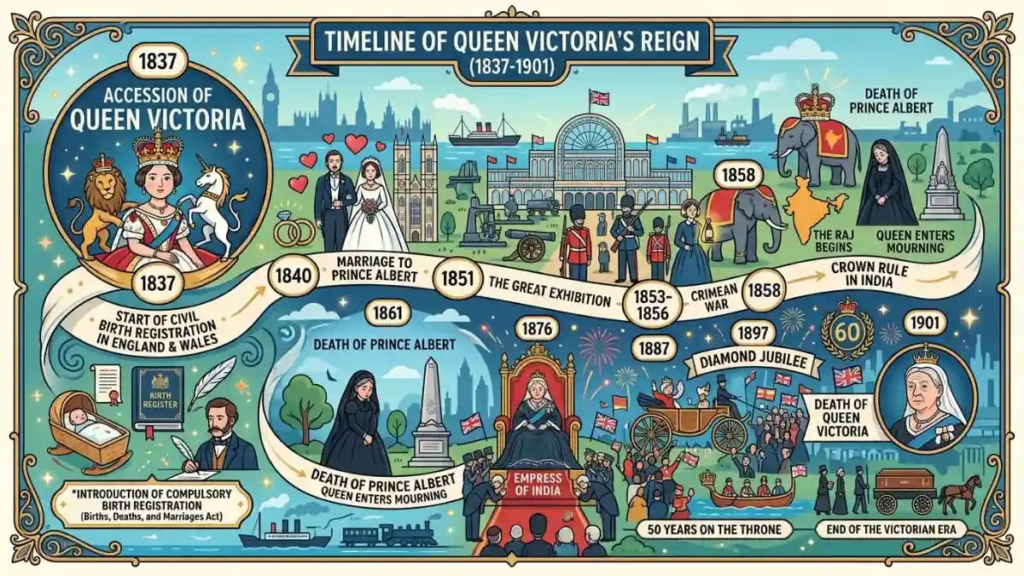
A quick note on sources: birth registration in England and Wales began in 1837, so rankings from this period rest on real records. Name meanings have long histories and can differ between sources, so this article gives the most widely stated meaning.
What Counts as a Victorian Name
Victorian names are the names in common use while Queen Victoria was on the throne, from 20 June 1837 to 22 January 1901. That covers most of the 19th century, so the term overlaps heavily with names from the 1800s.
The period was long, so tastes changed. A name that felt fresh in 1840 could feel dated by 1890, and some names belong clearly to the early, middle or late part of the reign.
Place matters too. Most examples here reflect Britain. National name statistics in the United States begin later, in 1880, so American lists of 19th-century names can look different.
The Most Popular Victorian Names
Across the whole reign, William, John, George and Thomas stayed at the top for boys, while Mary, Elizabeth, Sarah and Ann led for girls. These are the names you will meet most often in Victorian names records.
| Trend | Boys | Girls |
| Held the top spots all reign | William, John, George, Thomas | Mary, Elizabeth, Sarah, Ann |
| Gained ground during the reign | Albert (rose after 1840) | Florence, Edith, Ethel, Gladys, Winifred |
Ethel, Gladys and Winifred are usually described as late Victorian names. Albert’s rise after 1840 matches the year Victoria married Prince Albert.
These groupings come from name-history sources that summarise birth registers, so read them as broad trends, not exact rankings. For precise numbers, check official registration data.
How Victorians Chose Names
Victorian parents drew on a small set of influences, and most names on the lists below trace back to one of them.
- Faith. Biblical names were the most common choice, including Samuel, Jacob, James, Joseph, John, Peter and Thomas for boys, and Ruth, Sarah, Mary and Hannah for girls.
- Royalty. Names such as Victoria, Albert, Alexandra and Arthur gained popularity through the royal family.
- Virtue. Parents liked names that named a good quality, such as Grace, Faith and Constance.
- Nature. Flower names grew fashionable in the 1880s and 1890s.
- Family. Names were often handed down through generations, so one name can repeat across several relatives.
- Books. One academic study cited by name sites suggests that upper middle class families began borrowing names from popular print culture.
Victorian Girl Names and Their Meanings
Girls’ names ranged from formal royal picks to sweet short forms. They are grouped below by the feel of the name, so you can browse by style.
Classic and Royal Girl Names
- Mary – Hebrew origin, meaning debated
- Elizabeth – God is my oath
- Sarah – princess
- Ann – grace, a form of Hannah
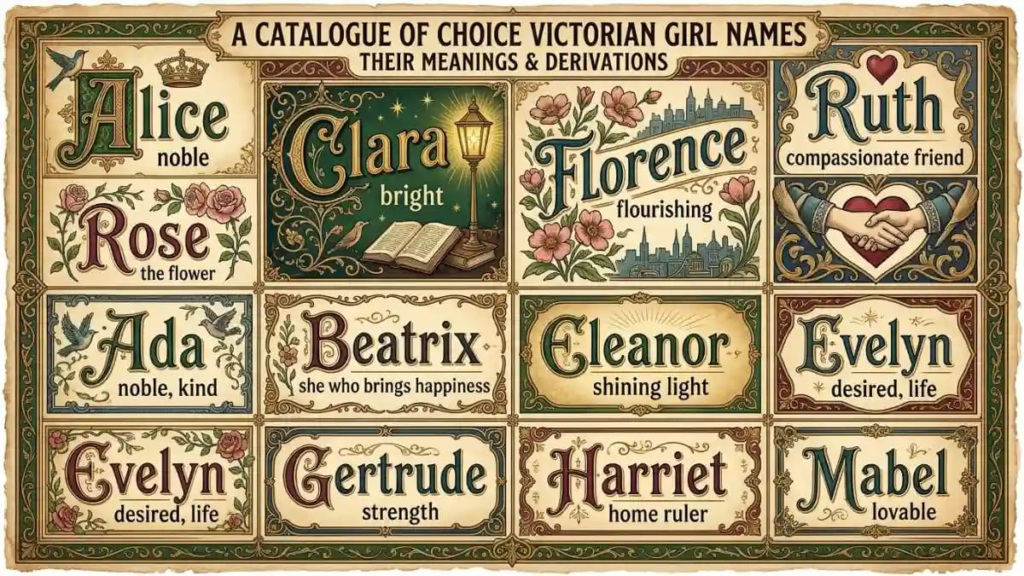
- Alice – noble
- Charlotte – free man, the feminine form of Charles
- Emma – whole, universal
- Clara – bright, clear
- Florence – flourishing
- Beatrice – she who brings happiness
- Matilda – mighty in battle
- Victoria – victory
- Adelaide – noble and kind
- Alexandra – defender of mankind
- Louisa – renowned warrior
- Helena – light, torch
Biblical Girl Names
- Ruth – compassionate friend
- Hannah – grace
- Lydia – woman from Lydia, an ancient region
- Josephine – God will add
- Esther – star
- Naomi – pleasantness
Flower and Plant Names
Flower names became genuinely fashionable in the late Victorian period, roughly the 1880s and 1890s. They were part of a wider turn toward sentimental, nature-inspired naming.
- Rose – the flower
- Lily – the flower, a symbol of purity
- Daisy – the flower, from “day’s eye”
- Violet – the flower and the colour
- Iris – rainbow, also the flower
- Myrtle – the evergreen shrub
- Flora – Roman goddess of flowers
Virtue Names
- Grace – divine favour
- Faith – trust, belief
- Hope – expectation, optimism
- Constance – steadfast
- Patience – calm endurance
- Prudence – careful judgement
- Charity – kindness, love
Late Victorian Favourites
- Ethel – noble
- Edith – prosperous in war
- Gladys – Welsh origin, meaning uncertain
- Winifred – Welsh origin, meaning debated
- Mabel – lovable
- Maud – a short form of Matilda
- Ada – noble
- Eleanor – meaning unknown
Short Forms Used as Full Names
We may think of Victorian girl names as formal and buttoned-up. In fact, parents often used short forms as full names, and many end in -ie.
- Annie – short for Ann or Anne
- Minnie – often short for Mary or Wilhelmina
- Nellie – short for Eleanor or Helen
- Bessie – short for Elizabeth
- Hattie – short for Harriet
- Lottie – short for Charlotte
- Polly – short for Mary
- Elsie – short for Elizabeth or Elspeth
- Kitty – short for Catherine
- Betsy – short for Elizabeth
Victorian Boy Names and Their Meanings
Boys’ names leaned on the Bible, the monarchy and family tradition. Later in the era, more polished gentleman names arrived.
Everyday Favourites
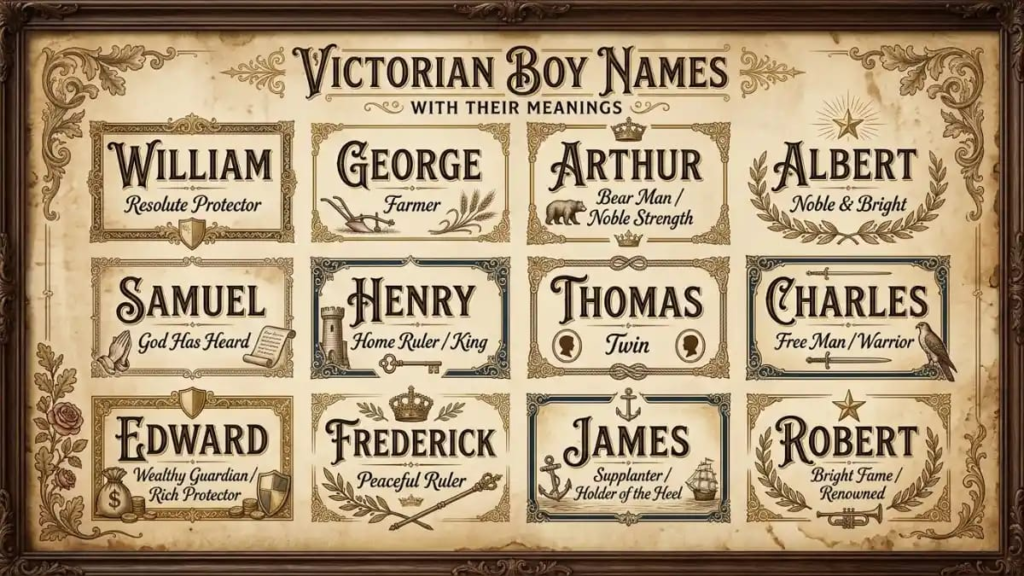
- William – resolute protector
- John – God is gracious
- George – farmer
- Thomas – twin
- Henry – ruler of the home
- James – supplanter
- Charles – free man
- Edward – wealthy guardian
- Joseph – God will add
- Frederick – peaceful ruler
- Alfred – wise counsel
- Albert – noble and bright
- Arthur – origin debated
- Walter – ruler of the army
- Herbert – bright army
- Ernest – serious, determined
Biblical Boy Names
- Samuel – God has heard
- Jacob – supplanter
- Peter – rock
- Daniel – God is my judge
- Benjamin – son of the right hand
- David – beloved
- Isaac – he laughs
Gentleman Names of the Late Victorian Era
- Percy – from a Norman place name
- Reginald – counsel and rule
- Sidney – from a surname, meaning debated
- Cecil – origin debated
- Clarence – from a royal title and place name
- Harold – army ruler
- Leonard – brave lion
- Archibald – genuine and bold
- Bertram – bright raven
Classical and Heroic Names
To a lesser extent, Victorian parents copied names from heroes of mythology and ancient literature, such as Achilles and Hector.
- Hector – Trojan hero
- Achilles – Greek hero of the Trojan War
- Horatio – Roman family name, later linked with Admiral Nelson
- Julius – Roman family name
- Augustus – venerable, majestic
- Cornelius – Roman family name
Boys’ Nicknames
- Frank – short for Francis
- Dick – short for Richard
- Fred – short for Frederick
- Harry – short for Henry or Harold
- Bertie – short for Albert or Herbert
Royal Victorian Names: Queen Victoria’s Family
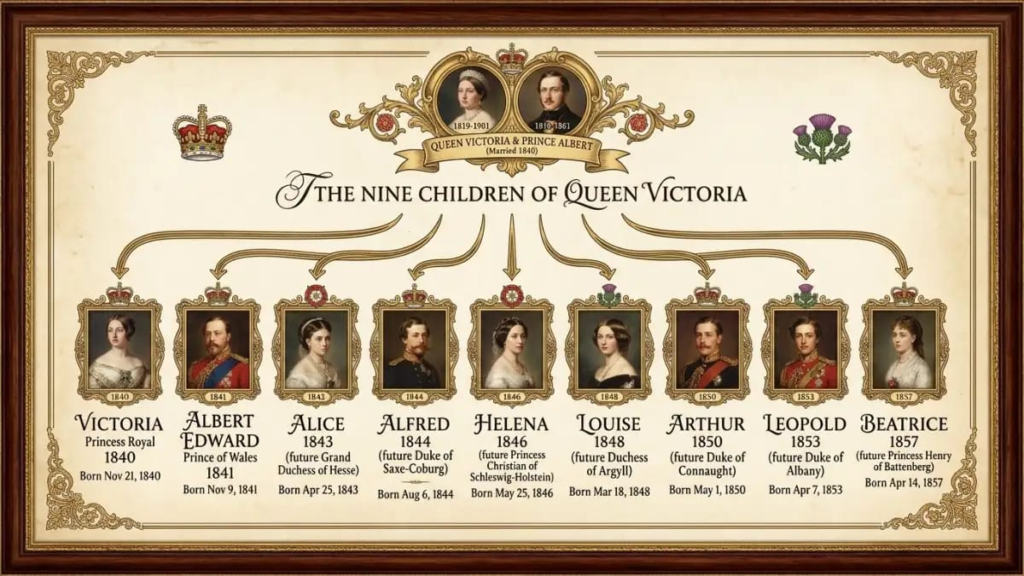
The queen’s own name was a compromise. She was christened Alexandrina Victoria, and other names her parents proposed, Georgina, Charlotte and Augusta, were dropped on the instructions of the Prince Regent.
Victoria and Prince Albert had nine children, five girls and four boys. The table shows their names and the family nicknames that are widely recorded.
| Child | Born | Family nickname |
| Victoria | 1840 | Vicky |
| Albert Edward | 1841 | Bertie |
| Alice | 1843 | None recorded here |
| Alfred | 1844 | Affie |
| Helena | 1846 | Lenchen |
| Louise | 1848 | None recorded here |
| Arthur | 1850 | None recorded here |
| Leopold | 1853 | None recorded here |
| Beatrice | 1857 | Baby |
For parents, this list is a ready-made shortlist. Alice, Helena, Louise and Beatrice carried royal glamour, and they still sound elegant today. Prince Albert himself was born Franz August Karl Albert Emanuel, a reminder of how long royal names could run.
Names from Victorian Literature
Victorian readers met new names in serialised novels, and some of those names still feel tied to the books that made them famous. Charles Dickens is the best-known example.
- Oliver – Oliver Twist by Charles Dickens
- Pip – Great Expectations, short for Philip
- Estella – Great Expectations
- Esther – Bleak House
- Nicholas – Nicholas Nickleby
- Ebenezer – A Christmas Carol
- Sydney – A Tale of Two Cities, as in Sydney Carton
- Jane – Jane Eyre by Charlotte Brontë, published 1847
Rare Victorian Names
Some Victorian names were uncommon even then, and they stand out today. If you want something distinctive but still historical, start here.
- Ottilie – prosperity, from a Germanic saint’s name
- Theodosia – gift of God
- Euphemia – well spoken
- Araminta – a name that appeared in a 17th-century play
- Isolde – from the legend of Tristan and Isolde
- Rosamund – meaning debated, often linked with roses
- Peregrine – traveller, pilgrim
- Algernon – moustached
Victorian Names Today
Several Victorian girl names have returned to fashion, including Violet, Mabel, Phoebe and Ada. Their short, soft sounds fit modern taste, which is part of why they work.
Others still feel firmly tied to the 19th century, including Bertha, Gertrude, Myrtle, Clarence, Herbert and Elmer. That can be an advantage if you want a bold vintage choice.
To keep the Victorian feel without sounding dated, pair a revived name with a modern middle name, or choose the short form as the full name.
Researching Victorian Names in Family Records
If you are tracing ancestors, Victorian names come with a few quirks. These sources are the usual starting points.
- Civil registration. Births in England and Wales have been registered since 1837, which makes the Victorian period well documented.
- Census returns. Mid-century census data shows steady use of common names across England, Scotland and Wales.
- Parish registers. Baptism entries record names that may differ from what a person later used.
Because short forms were used as full names, search under both versions, such as Hattie and Harriet. Also check dates carefully, since names repeated across generations of the same family.
How to Choose a Victorian Name
- Pick a mood first. Decide whether you want royal, biblical, floral, virtuous or literary, then shortlist from that group.
- Check the nickname. Victorian names came with built-in short forms, so decide which ones you like.
- Say the full name aloud. Try first, middle and surname together, since rhythm matters.
- Confirm the meaning. Where sources disagree, check a trusted name dictionary before you commit.
- Think about today. Some Victorian names are now common again, others are rare, so decide how distinctive you want to be.
Final Thoughts
Victorian names mix faith, royalty, virtue and nature, and they cover a wide range from William and Mary to Ottilie and Algernon. The most common names were simple, while the late Victorian era added flowers and more polished gentleman names.
Whether you are naming a child, writing a character or tracing a family tree, start with the era’s main influences. They explain most of the choices in the records, and they make it easier to spot which names feel authentic.
FAQs
What are Victorian names?
Names commonly used during Queen Victoria’s reign, from 1837 to 1901.
What were the most popular Victorian boy names?
William, John, George and Thomas stayed at the top through most of the reign.
What were the most popular Victorian girl names?
Mary, Elizabeth, Sarah and Ann led for girls across the period.
Were flower names popular in Victorian times?
Yes, especially in the 1880s and 1890s. Rose, Lily, Daisy, Violet, Iris and Myrtle were common.
What did Queen Victoria name her children?
Victoria, Albert Edward, Alice, Alfred, Helena, Louise, Arthur, Leopold and Beatrice.
Did Victorians use nicknames as real names?
Yes. Short forms such as Annie, Minnie, Nellie and Bessie were often used as full names.
Which Victorian names are back in fashion?
Violet, Mabel, Phoebe and Ada are among the girl names that have returned.
Are Victorian names the same as names from the 1800s?
Mostly. The Victorian era covers most of the 19th century, so the two lists overlap heavily.