
French last names carry a lot of history in a few letters. A single surname can point to a saint, a trade, a hillside or a hair colour. That is why people search for French last names when they research family roots, write a story or simply wonder what their own name means.
French last names mostly come from first names, trades, places and nicknames. Martin is the most common, followed by names like Bernard, Thomas, Petit and Durand. This guide lists 50 French last names with meanings, explains particles like de and le, and shows how to trace your roots.
Where experts disagree about a meaning, the entry says so. That matters because some online lists repeat mistakes, such as saying Dupont means two bridges. It actually means of the bridge.
How French Last Names Work
Most French last names became hereditary in the Middle Ages. Before that, people often used one name. As towns grew, a second name was added to tell people apart, and over time that second name passed from parent to child.
French last names follow a few simple habits. Many begin with Le, La, Du, Des or De, which are small words meaning the, of the or of. Le Roux means the red-haired one, and Dubois means of the woods.
Do not assume that de marks a noble family. Names with de are often just place labels, such as Delacroix, meaning of the cross. Nobility is a separate question and needs records.
A law passed during the French Revolution, in 1794, restricted people from using any name other than the one on their birth record. That helped freeze French last names in the forms we see today.
The Main Types of French Last Names
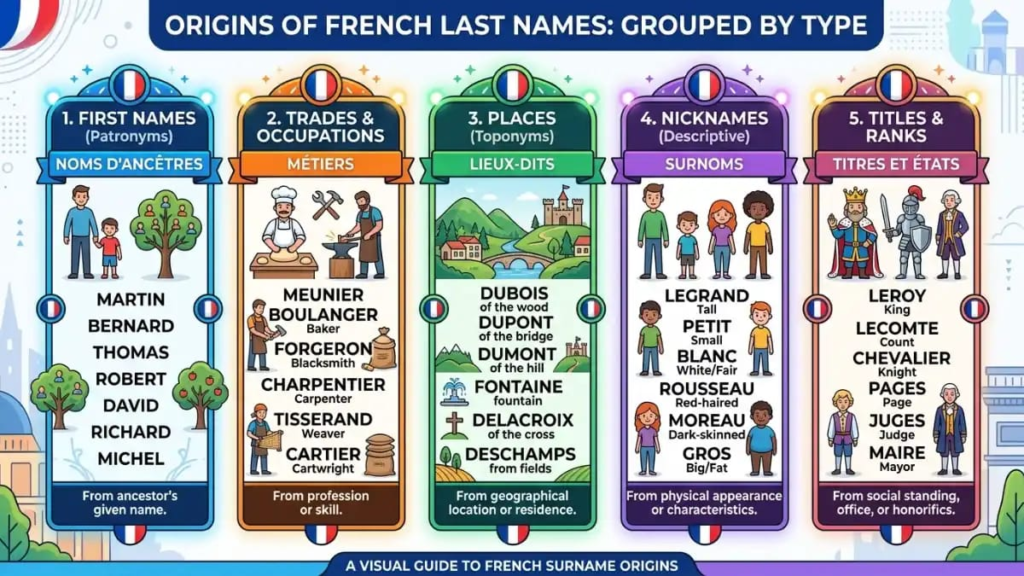
Nearly every French surname falls into one of five groups, though a few fit more than one.
- Patronymic: taken from a first name, like Martin or Bernard
- Occupational: taken from a trade, like Fournier
- Place-based: taken from a landscape or town, like Dupont
- Nickname: based on looks or character, like Roux
- Status and title: based on rank or role, like Chevalier
Experts sometimes disagree on a single name, so a few entries give two possible origins. That is normal in surname research.
Most Common French Last Names
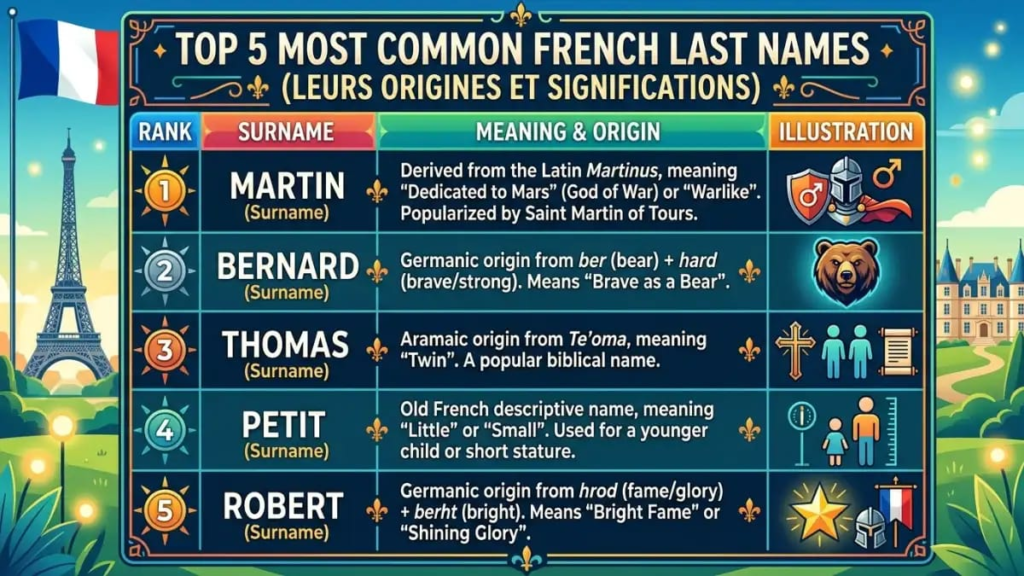
Martin is the surname most often listed first in France. After that, the order changes between sources and years, so treat rankings as a rough guide. Here are 15 of the most common French last names.
| Surname | Meaning | Good to know |
| Martin | From Latin Martinus, of Mars | Spread by the popularity of Saint Martin of Tours |
| Bernard | Germanic bern, bear, and hard, brave | Began as a personal name and became hereditary |
| Thomas | From Aramaic, twin | Linked to the apostle Thomas |
| Petit | Small | A nickname, sometimes for the smaller of two men with the same name |
| Robert | Germanic, bright fame | Another name that started as a first name |
| Richard | Germanic, powerful ruler | Often explained as strong and brave |
| Durand | From Latin durandus, enduring | Once a personal name, later a surname |
| Dubois | Of the woods | A place or landscape name for someone near a forest |
| Moreau | Dark-haired or dark-skinned | Reported as especially common in western France |
| Laurent | From Latin Laurentius | Often linked to laurel or to Laurentum |
| Simon | From Hebrew, he has heard | A biblical first name used as a surname |
| Michel | From Hebrew, who is like God | The French form of Michael |
| Lefebvre | The smith, from Old French fevre | Spelling varies, including Lefèvre and Lefevre |
| Leroy | The king | Possibly a nickname or a role in a play or festival |
| Roux | Red-haired | A nickname that also appears as Le Roux and Leroux |
Notice how many of these French last names started as first names. Martin, Bernard, Thomas, Robert, Richard, Simon, Michel and Laurent were all given names first.
Spelling can differ from family to family. Lefebvre, Lefèvre and Lefevre share the same root, which matters when you search records.
Surnames From Trades and Jobs
Trade names show what a medieval village needed every day: bread, flour, meat, wood and wool. These are usually easy to translate.
| Surname | Meaning | Good to know |
| Fournier | Baker or oven keeper | From four, oven |
| Meunier | Miller | Someone who ran the mill |
| Boucher | Butcher | From boucher, to slaughter |
| Boulanger | Baker | A close relative of Fournier |
| Berger | Shepherd | A direct word for the job |
| Charpentier | Carpenter | From the French word for carpentry |
| Mercier | Mercer, a seller of small goods | A common merchant trade |
| Marchand | Merchant | From marchand, trader |
Status and Title Surnames
Some surnames point to rank instead of work. They did not always mean the family was grand. A name like Lecomte might have been a nickname, a servant’s label or a stage role.
| Surname | Meaning | Good to know |
| Chevalier | Knight | A rider or someone linked to a knight |
| Leclerc | The clerk or scholar | From clerc, a man who could read and write |
| Lemoine | The monk | Possibly a nickname or a link to a monastery |
| Lecomte | The count | Often a household or nickname origin |
| Lemaire | The mayor | A local official or a nickname |
French Last Names From Places and Landscape
Place names are some of the most common French last names. They describe where a family lived, not always where it lives now.
| Surname | Meaning | Good to know |
| Dupont | Of the bridge | From du pont. Not two bridges |
| Dumont | Of the mountain | From du mont |
| Duval | Of the valley | From du val |
| Fontaine | Fountain or spring | Someone living near a spring |
| Rivière | River | Someone living by a river |
| Lacroix | The cross | Near a roadside cross |
| Deschamps | Of the fields | From des champs |
| Picard | From Picardy | A regional label |
Surnames From Nicknames
Nicknames were a quick way to separate two men with the same first name. A pale man became Blanc, a dark one Brun, and a lively one Gaillard.
| Surname | Meaning | Good to know |
| Blanc | White | Pale skin or hair |
| Brun | Brown | Brown hair or skin |
| Rousseau | Little red | From roux, with a small ending |
| Legrand | The big | A tall or important person |
| Gaillard | Bold or lively | A spirited person |
| Renard | Fox | A clever or sly person |
Surnames From First Names
Beyond the very common ones above, many other surnames began as saints’ names or old Germanic names. They look like first names because they were.
| Surname | Meaning | Good to know |
| Girard | From Germanic Gerard | Often explained as spear and brave |
| Lambert | From Germanic land and bright | Linked to a saint of that name |
| Vincent | From Latin vincens, conquering | A saint’s name |
| Nicolas | From Greek, victory of the people | A saint’s name used across Europe |
Regional French Last Names
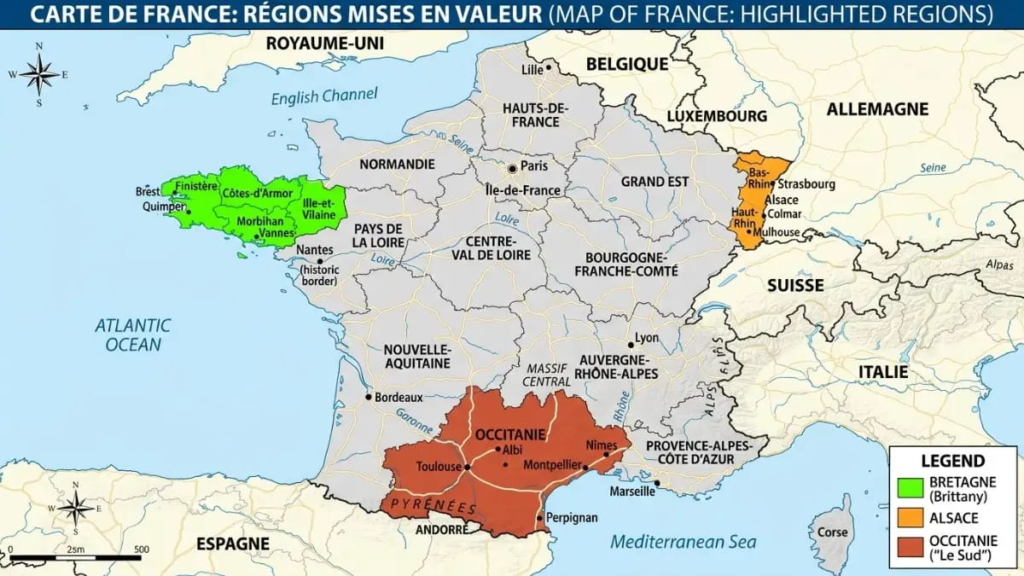
France is not one naming culture. Regional surnames show the languages and neighbours of each area.
| Surname | Meaning | Good to know |
| Le Goff | The smith, in Breton | A typical Breton surname |
| Schmitt | Smith, from German | Common in Alsace and Lorraine |
| Fabre | Smith, from Occitan | Found in the south |
| Garcia | Of Spanish origin | Common in southern France through migration |
Brittany
Breton names often start with Le or Kerr, a Breton word linked to a farm or settlement. Le Goff is one of the best known.
Alsace and Lorraine
Close ties to Germany mean many surnames here sound German, such as Schmitt, Muller and Schneider. They are fully French families.
The South
Occitan, Catalan and Spanish influence shows in names like Fabre and Garcia. Smith names appear under several forms across France: Lefebvre in the north, Fabre in the south and Le Goff in Brittany.
What Do Particles Like Le, De and Du Mean?
Small words before a name change its meaning. Le and La mean the, as in Le Roux. Du means of the, as in Dubois. De means of, as in De Lacroix. Des means of the, in the plural, as in Deschamps.
Sometimes the particle is joined to the name, as in Lefebvre and Leclerc. Sometimes it stays separate, as in Le Goff. Both forms exist, so search for each when you trace French last names in records.
Accents, Hyphens and Spelling
Accents appear in some surnames, such as Rivière and Lefèvre. Many databases drop accents, so a family may appear with and without them.
Hyphenated names are also common in modern France, especially now that parents may give a child both surnames. If you search a record and find nothing, try removing accents, spaces and hyphens.
How French Last Names Work Today
In France, a woman keeps her birth name after marriage. She can use her husband’s name as a usage name, but her legal name stays the same.
Since 2005, parents can give their child the father’s name, the mother’s name or both. A 2022 law also made it easier for adults to add or switch to their mother’s name. Check the current rules if you need an official answer.
French Last Names in Canada and the United States
Many French surnames crossed the Atlantic. In Quebec and in Cajun Louisiana, you will find names like Boudreaux and Landry beside Martin and Bernard.
Quebec also has dit names, where an extra name followed the family name, such as Lafleur or Larose. These started as nicknames in the French colonial period and sometimes became the main family name.
Spellings changed over time because clerks wrote what they heard. That is why one family can appear as Thibodeaux, Thibodeau and Thibault in different records.
How to Trace French Last Names
A surname is a clue, not proof. Records give the real answer. Here is a simple path.
- Start with what your family knows: full names, birth years and any town names
- Find the commune, the town or village of origin, because records are kept by place
- Look at civil records, which started in 1792, and parish registers, which go back further in many places
- Search spelling variants, such as Lefebvre, Lefèvre and Lefevre
- Check department archives and well-known genealogy sites, and confirm what they cover
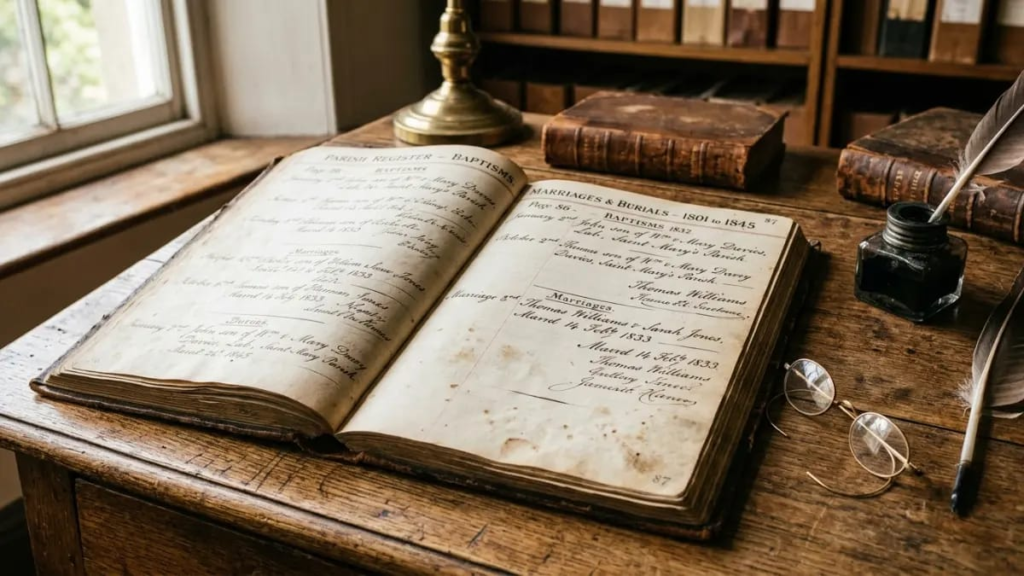
Handwriting in old registers can be hard to read, and some are in Latin. Names were sometimes written the way a clerk heard them, so expect more than one spelling.
French Last Names for Characters and Stories
Writers and game designers often look for surnames that fit a character’s background. Pick a name that suits the region and the era.
- Camille Dubois: a simple, believable name for a modern city character
- Julien Fournier: a trade name with a working-family feel
- Élodie Lefebvre: a northern name with a classic look
- Pierre Le Goff: a Breton character with a clear regional flavour
- Marie Garcia: a southern character with Spanish roots
Skip the dramatic aristocratic names unless the story needs them. Most French families have ordinary names, and ordinary names make characters feel real. [Internal link: French first names]
Final Thoughts
French last names are small stories. One name can tell you about a father, a bakery, a bridge or a hair colour. Once you know the patterns, you start to read them with ease.
If you are tracing your own family, treat the meanings here as clues and the records as proof. If you are writing fiction, match the surname to the region. Either way, French last names reward a little curiosity.
FAQs
What is the most common French last name?
Martin is the surname most often listed first in France. Bernard, Thomas, Petit and Durand also rank near the top.
What do most French last names mean?
They mostly come from first names, trades, places and nicknames. Dubois means of the woods, Fournier means baker and Roux means red-haired.
Does de in a French surname mean the family is noble?
Not always. De often marks a place or a father’s name, so it does not prove noble status.
Do French women change their last name when they marry?
No. A French woman keeps her birth name and may use her husband’s name as a usage name.
What is the difference between Le and La in French surnames?
Le means the for masculine words and La means the for feminine words. Le Roux means the red-haired one.
Are French last names always spelled with accents?
No. Names like Rivière and Lefèvre use accents, but many records drop them, so search both forms.
What does dit mean in a French last name?
Dit means called. In Quebec, a dit name is an extra name added to a family name, like Lafleur.