
French names are first names used in France and French-speaking countries, from classics like Louis and Charlotte to softer choices like Capucine and Maël. Most come from Latin, Greek, Hebrew or old Germanic roots and were reshaped by French speech. Each one carries a meaning, such as noble, golden, free or strong. Below you will find 60 picks with meanings and tips.
How French Names Work
Before you choose, it helps to know how the system works. French names follow a few habits that surprise many English speakers.
First, middle names in the English sense do not exist in France. A person may have several given names on paper, but the first one is the one in daily use, and initials are not used for the others. Second, compound given names are common, such as Jean-Pierre or Marie-Claire, and two names joined by a hyphen are treated as one.
Third, almost all traditional French names are gender-specific, and many female names are feminine forms of male ones. Charlotte comes from Charles, and Laurence is the feminine version of Laurent. A small group, such as Dominique, can be used for either sex.
Finally, the law is flexible. Since 2005, parents in France can give their child either parent’s surname or a hyphenated combination of both, with a limit of two. French women do not legally change their names when they marry, though many use a husband’s name as a usage name in daily life.
Where French Names Come From
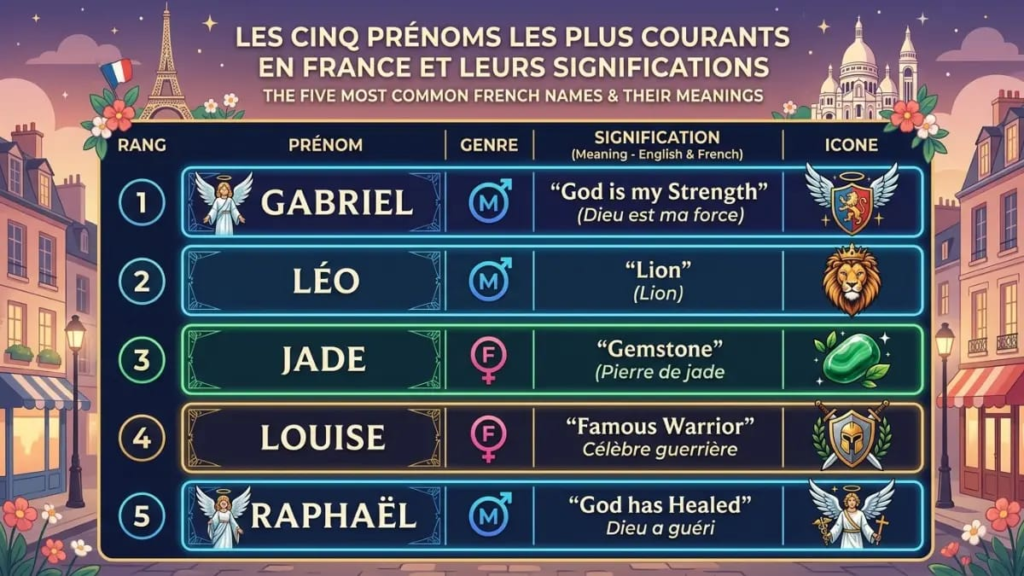
Many started in Latin. Valentine, Désirée and Félicité all have Latin roots, and Dominique means of the Lord. Others come from Greek or Hebrew, such as Jean, which means God is gracious. A third group comes from old Germanic and Frankish names. Louis is the French form of the Old Frankish name Chlodwig, which is explained as famed warrior.
That mix of sources is why French names feel so varied. A single family can have a Latin name, a Hebrew name and a Frankish name side by side, all pronounced in the same smooth French way.
French Girl Names and Meanings
French girl names are known for soft sounds and graceful endings. Many end in -e, -ine or -elle, and many carry meanings about beauty, nobility or nature.
| Name | Meaning | Note |
| Adèle | Noble | Short and classic |
| Amélie | Hardworking | Light and familiar |
| Anaïs | Grace | Variation of Anna |
| Ariane | Most holy | Rare and elegant |
| Aurélie | Golden | Warm and bright |
| Béatrice | Bringer of joy | Traditional |
| Capucine | Nasturtium | Flower name |
| Chantal | Singer | Musical meaning |
| Charlotte | Free | Feminine form of Charles |
| Chloé | Green shoot | Fresh and modern |
| Clara | Bright, clear | Easy across languages |
| Mireille | Miracle | Soft and uncommon |
| Aimée | Beloved | Simple and sweet |
| Régine | Queen | Regal |
| Thérèse | Harvest | Vintage feel |
| Valentine | Strong | Used for girls in France |
Charlotte, Clara and Chloé travel well outside France because English speakers already know how to say them. Names like Mireille and Capucine are better if you want something that feels truly French.
French Flower Names
Flowers are a favourite source. Capucine means nasturtium, a plant used in cooking and herbal tea. Violette means purple, and Fleurine means little flower. Rose, Marguerite and Jasmine are also used in France and are easy for English readers. These names suit parents who want something gentle but not overused.
Elegant and Regal Girl Names
Some names carry a sense of status. Régine means queen, Adèle and Adélie mean noble, and Laurence means winner. Désirée means desired, and Félicité means fortune, which gives the name a lucky feel. These choices fit a classic or formal style.
French Boy Names and Meanings
French boy names tend to be short, crisp and rooted in saints, kings and soldiers. Many end in a silent letter, which is part of their charm.
| Name | Meaning | Note |
| Louis | Famed warrior | Royal and timeless |
| Jules | Youthful | Short and popular |
| Arthur | Noble, courageous | Popular in France |
| Maël | Chief, prince | Breton favourite |
| Pierre | Stone, rock | French form of Peter |
| Jean | God is gracious | Very traditional |
| Henri | Home ruler | Classic royal name |
| Étienne | Garland, crown | French form of Stephen |
| Rémy | Oarsman | Soft and friendly |
| Olivier | Olive tree | Gentle and classic |
| Antoine | Praiseworthy | Smooth and old-fashioned |
| Dominique | Of the Lord | Often unisex |
| Loïc | Breton form linked to Louis | Strong regional feel |
| Adrien | Linked to a place name, Hadria | Calm and polished |
Louis is a good example of a name with a long history. It goes back to the Frankish name Chlodwig, and many French kings carried it. Jules, Arthur and Maël are among the names that families in France have chosen in recent years.
Short and Modern Boy Names
If you like brevity, Jules, Maël and Rémy all fit the mood. They are easy to say, easy to spell and carry a gentle sound. Parents who want to avoid heavy royal names often go this way.
Classic and Royal Boy Names
For something more formal, Louis, Henri, Étienne and Antoine have a long history. These names feel at home in a family tree, and they age well. They also age well and suit both formal and everyday settings.
Unisex French Names
Most are gender-specific, but a few are not. Dominique is the best-known example and means of the Lord. Camille and Claude are also used for both sexes in France.
If you use a unisex name, think about the spelling. In French, the spelling of the ending often signals gender. Camille is the same for both, while Dominique and Dominic differ by ending. Check how the name looks on forms and school lists.
Breton and Regional French Names
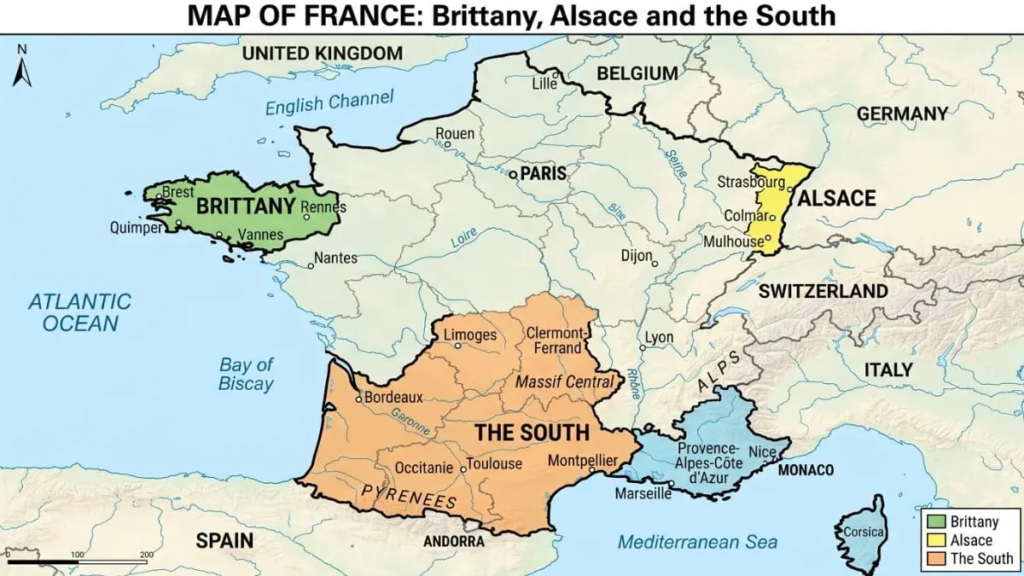
France is not one culture. Brittany in the west has its own naming tradition, and some names are strongly tied to it. Loïc is chiefly used in Brittany and in Breton communities abroad, and Maël is also a Breton-linked favourite. Both can feel fresh outside France while still being rooted.
Other regions have their own habits, from Occitan names in the south to Alsace names in the east. If you are writing a character from a particular region, a quick check of local naming can add real depth. A character from Brittany named Loïc is more convincing than one named Pierre.
French Names for Writers and Characters
Writers often search for French names to build a believable cast. A good rule is to match the name to the era. A modern Parisian teenager is more likely to be named Jules, Léa or Chloé. A historical character from the seventeenth century is more likely to be Louis, Henri, Marguerite or Étienne.
Compound names are also useful. Jean-Pierre, Marie-Claire and Anne-Sophie are classic, and they give a character an instant French feel. Add a surname that fits, and the character comes alive.
French Names for Twins and Siblings
Naming more than one child gives you room to play with themes. French names pair well when they share a feeling rather than a sound.
- Aurélie and Clara, two bright names that mean golden and clear
- Louis and Jules, a classic royal name beside a short youthful one
- Capucine and Violette, two flower names for sisters
- Maël and Loïc, two Breton-linked names for brothers
- Charlotte and Henri, a formal pair with a long family history
Try not to choose pairs that rhyme or share the same ending, because they are harder to call across a room. Say the names together as if you were calling the children for dinner.
French Names by Meaning
Sometimes the meaning matters more than the sound. If you want a name that means strong, Valentine fits. If you want noble, choose Adèle or Arthur. For joy, Béatrice is a good fit, and for a gift of God, Dominique or Jean can work. For nature, Capucine, Violette, Chloé and Olivier give you flowers, new growth and trees.
Meanings are easier to trust when two or three sources agree. When they differ, give the most widely accepted meaning and note that others exist. That small habit keeps you honest, especially if you plan to write the meaning on a baby announcement or in a story.
Nicknames and Short Forms
These names often have short, affectionate forms. Virginie can become Gigi, and Marguerite can become Margot. Charlotte can be Lotte. These short forms are warm and informal, and they are used by family and close friends.
Short forms matter when you choose a long name. If Marguerite feels too formal, Margot gives the child an easy everyday option.
Accents, Spelling and Pronunciation
The accents on French names matter, and they change how a name is said. The grave accent in Adèle and the acute accent in Chloé and Aimée mark sound. The diaeresis in Anaïs and Loïc tells you to say each vowel separately.
Pronunciation has a few rules that cover most names.
- Final consonants are often silent, so Louis is said LOO-ee
- The r is soft and made at the back of the throat
- Dominique is said doh-mee-NEEK
- Anaïs is said ah-nah-EES
- Chloé is said kloh-AY
If you plan to live outside France, think about whether you will keep the accents. Many forms and databases cannot handle them, so you may need a version without accents for official documents. Decide early and be consistent.
French Names in English-Speaking Countries
Many French names are already familiar in English. Charlotte, Chloe, Claire, Louis and Henry all have French roots or French forms. Names like Amélie and Clara cross borders easily. A name like Mireille or Capucine is rarer and will often need spelling out.
A helpful trick is to pick a French name with an English-friendly sound. Clara, Jules and Louis are good examples. If you want a more distinct name, choose one with a simple spelling, such as Maël or Rémy.
English Cousins of French Names
Many English first names have a French twin, and knowing the pairs helps if you want a heritage touch. Pierre is Peter, Jean is John, Étienne is Stephen and Henri is Henry. Charlotte, Claire and Louis are shared almost unchanged. Using the French form gives a child a distinct name, while the English version is ready for school or work abroad. Families with relatives in both languages often use one as the legal name and the other as the everyday name.
Vintage French Names Coming Back
Some names fade and then return. Virginie peaked in France around 1975, and many parents now see it as ready for a comeback. Thérèse, Mireille and Régine also feel old-fashioned, which is exactly why some families love them.
Vintage names bring a sense of history and calm. They are a good choice if you want a name that feels rooted but not trendy.
How to Choose Among French Names
The sheer number of French names can make this hard. A few steps help.
- Say the name aloud with your surname
- Check the spelling and the accents
- Look up the meaning in more than one source
- Test the short form and see if you like it
- Ask a French speaker how it sounds
If you are choosing a name for a baby, sit with your short list for a week. A name that still feels right after seven days is usually the one.
Final Thoughts
French names combine sound, history and meaning in a way few other naming traditions do. From the golden Aurélie to the strong Valentine and from the famed warrior Louis to the youthful Jules, there is a name for every style. Check the meaning, say it aloud, and choose the spelling you will use for life. If you are naming a character, match the name to the place and the era. A well-chosen name does a lot of quiet work.
FAQs
What are the most popular French names?
For boys, Jules, Arthur, Louis and Maël are among the names families in France choose today. For girls, Charlotte, Clara, Chloé and Amélie are well known and widely used.
What do French names mean?
Most French names come from Latin, Greek, Hebrew or old Germanic roots, so their meanings vary. Common themes are nobility, strength, gifts from God and nature.
Do French people have middle names?
Not in the English sense. A French person may have several given names, but the first is the one used in daily life, and initials are not used for the rest.
What are unisex French names?
Dominique is the best-known example, and Camille and Claude are also used for both sexes. Most other traditional names are gender-specific.
How do you pronounce French names correctly?
Final consonants are often silent, and accents mark vowel sounds. For example, Louis is said LOO-ee and Chloé is said kloh-AY.
What is a nice French name for a baby girl?
Aurélie, Capucine, Mireille and Clara are lovely choices. Aurélie means golden and Capucine means nasturtium.
What is a strong French name for a boy?
Louis (famed warrior), Arthur (noble, courageous) and Maël (chief, prince) are strong choices. Henri, meaning home ruler, is another classic.