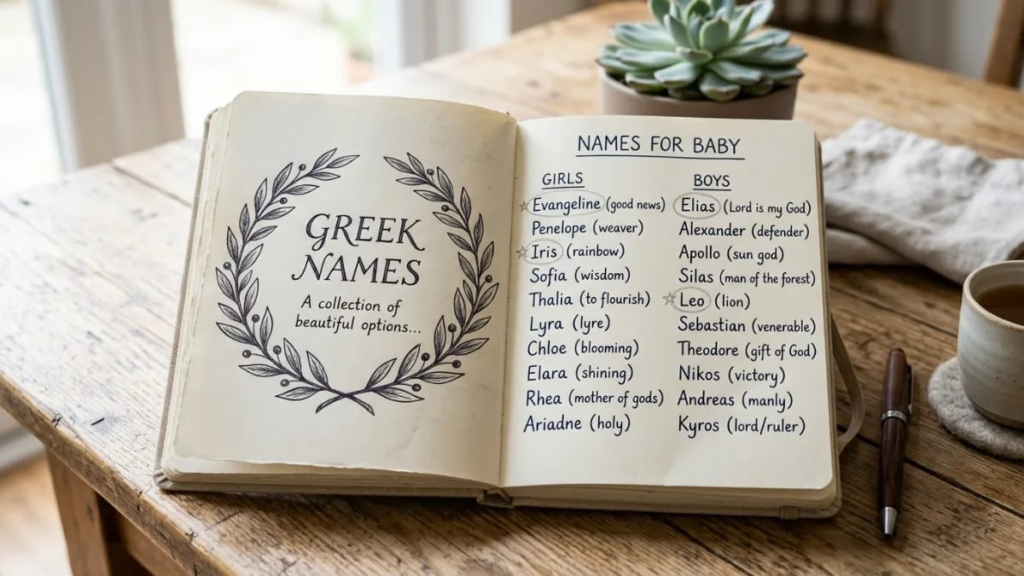

When most people search for greek names, they want to know what a name means, where it comes from and whether it suits their baby, character or story. Greek names are usually built from real Greek words, so each one tells you something: wisdom, victory, life, light or a god’s favour. Many have been used for more than 2,500 years and are still common in Greece today.
What Makes Greek Names Different?
Greek names are not random sounds. Most of them are real words, or two words joined together. Linguists who study ancient personal names point out that a vast number of Greek names are compounds. Nikomachos joins nike (victory) and mache (battle), while Sophokles joins sophos (wise) and kleos (glory).
This is why so many of them feel meaningful. You are not just choosing a pretty sound. You are choosing a small sentence about a person’s hoped-for character.
A few word parts keep appearing. Eu- means good or well, as in Eumenes (good mind) and Euphemos (good reputation). Theo- relates to god, Nike relates to victory, and Andr- relates to man. Once you know these building blocks, you can often guess the meaning of an unfamiliar name.
How Greek Names Sound and Look
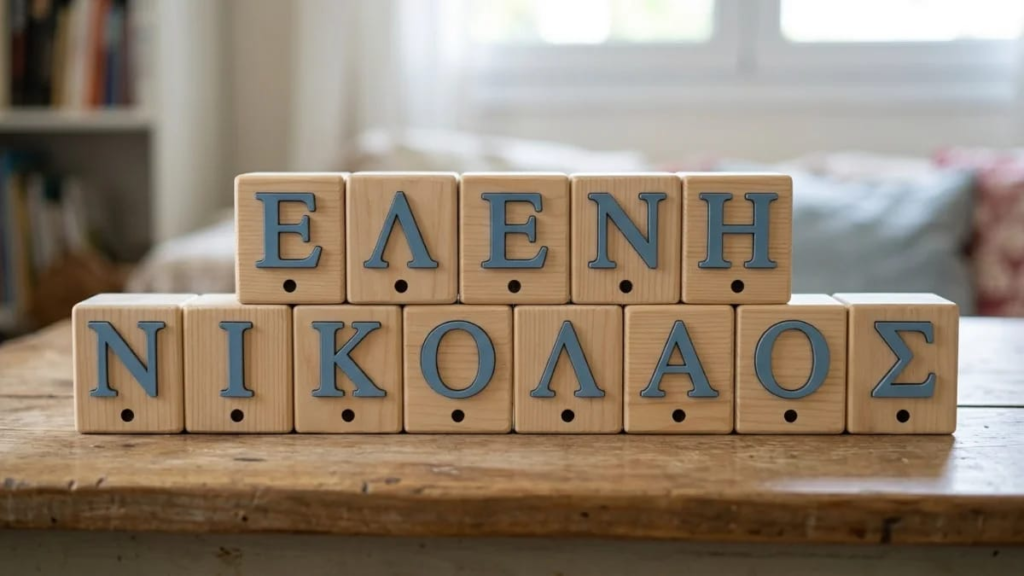
Male names often end in -as, -is, -os or -es, such as Andreas, Dimitris and Nikolaos. Female names commonly end in -a, -i or -ia, such as Sofia, Eleni and Anastasia. Greek is written in its own alphabet, so English spellings vary. Katerina, Ekaterini and Catherine are the same name in different clothes, and Yiannis, Giannis and Ioannis are all forms of John.
Popular Greek Names for Girls
Girls’ names in Greece come from goddesses, nature, virtues and the Christian tradition. Here are some of the most loved ones.
| Name | Meaning | Note |
| Sofia | Wisdom | Very common in Greece and abroad |
| Zoe | Life | Short, simple and easy to pronounce |
| Eleni | Bright, shining light | Linked to Helen of Troy |
| Katerina | Pure | A variant of Aikaterine |
| Anastasia | Resurrection | Feminine form of Anastasios |
| Theodora | God-given | Worn by Byzantine empresses |
| Maria | Often linked to Mary | Strongly tied to religious tradition |
| Daphne | Laurel tree | A nymph in the myth of Apollo |
| Nefeli | Cloud | Gentle and modern sounding |
| Myrto | Myrtle | A less common nature name |
| Kalliopi | Beautiful voice | The muse of epic poetry |
| Xenia | Guest-friendship | Reflects the Greek value of hospitality |
Sofia and Zoe work well outside Greece because people already know how to say them. Names like Nefeli and Kalliopi are a better fit if you want something rarer that still has a clear meaning.
Nature-Inspired Girl Names
Greece has a long coastline, olive groves and wild flowers, and the names reflect that. Anthea means flower, Iris means rainbow, Ilektra is linked to amber, and Xanthi points to golden or fair hair. These names suit parents who want something soft but not overused.
Popular Greek Names for Boys
Boys’ names tend to highlight strength, leadership and faith. Many are still used daily in Greece, often in a short form.
| Name | Meaning | Common short form |
| Nikolaos | Victory of the people | Nikos |
| Andreas | Manly, brave | Andreas |
| Alexandros | Defender of men | Alex, Alekos |
| Dimitrios | Follower of Demeter | Dimitris, Takis |
| Georgios | Farmer, earth worker | Giorgos |
| Ioannis | God is gracious | Giannis, Yiannis |
| Konstantinos | Steadfast | Kostas |
| Theodoros | Gift of God | Thodoris |
| Stefanos | Crown | Stefanos |
| Leon | Lion | Leon |
| Efthimios | In good spirits, generous | Thymios |
Some of these show how Greek names travel. Georgios becomes George in English, Ioannis becomes John, and Nikolaos becomes Nicholas. If you like the global versions, you can pick the Greek form as the formal name and use the familiar one day to day.
Strong Greek Names for Boys
Parents often look for strength, and Greek has plenty. Leon means lion, and Leonidas means son of the lion, after the Spartan king. Kratos means power or strength. Agamemnon means very steadfast. Eleftherios means the liberator, which makes it a strong choice for families who value freedom.
Mythological Greek Names
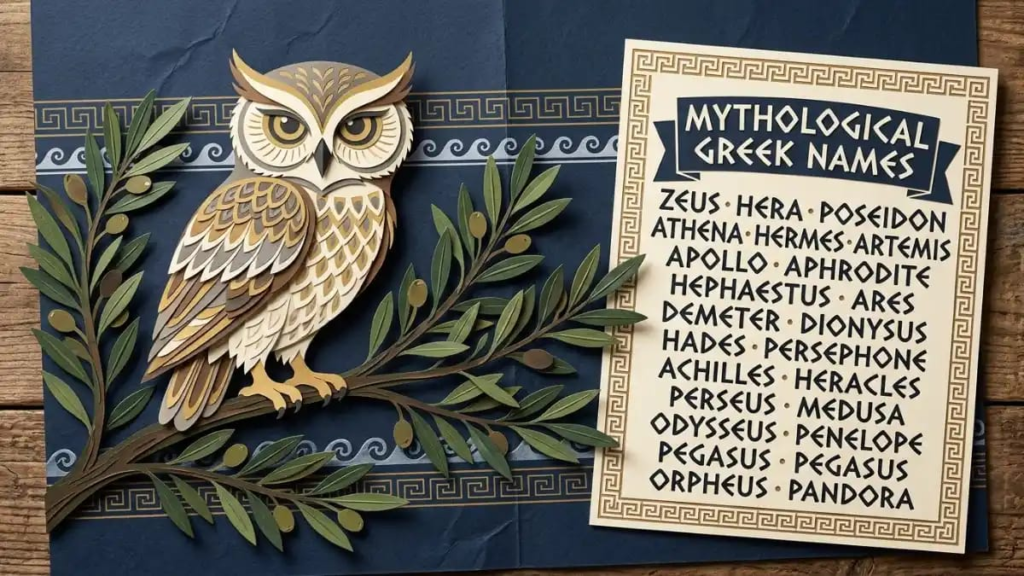
Greek mythology is the biggest source of dramatic names. Gods, heroes and nymphs have all lent their names to children for centuries.
For girls, Athena is the goddess of wisdom and crafts. Artemis is the goddess of the hunt, Persephone is linked to spring and the underworld, and Penelope is the loyal wife in the Odyssey. Themis means law or justice, and Theia means goddess or divine.
For boys, Achilles is the hero of the Trojan War, and his name is often explained as pain. Heracles means glory of Hera. Apollo, Hector, Orion and Jason also come from stories that Greeks have told for generations. Ajax is the warrior whose Greek form, Aias, is explained as earth mourner or eagle depending on the source.
One honest note: the meaning of a mythological name is sometimes debated. Scholars do not always agree on the origin of names like Achilles or Artemis. If a meaning matters to you, check more than one source.
Mythological Names That Work in Real Life
Some mythological names sound more natural than others. Athena, Daphne, Iris, Leo and Jason are easy for English speakers and rarely raise eyebrows. Names like Persephone, Agamemnon and Aphrodite make more of a statement. Think about how the name will sound on a school register or a work email before you decide.
Greek Origins Behind Everyday English Names
You may already know more of this vocabulary than you think. Many familiar English first names started life in Greece and travelled through Latin, French and other languages before reaching us.
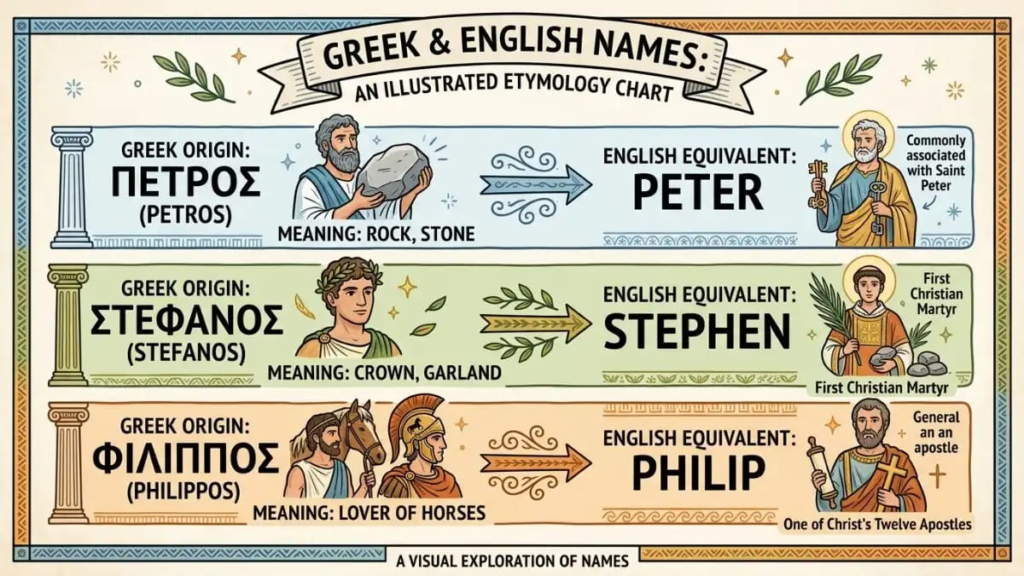
Peter comes from Petros, meaning rock. Stephen comes from Stefanos, meaning crown. Philip comes from Philippos, meaning lover of horses, and Theodore is a flipped form of Theodoros, meaning gift of God. Christopher comes from Christophoros, often explained as bearing Christ. Helen is the English cousin of Eleni, and Irene comes from Eirini, which is linked to peace.
Famous historical figures show the same pattern. Alexander the Great carried Alexandros, the defender of men. Cleopatra, a name used by Greek-speaking Macedonian queens in Egypt, is usually explained as glory of the father. The playwright Sophocles carried the compound meaning wise glory that we saw earlier.
This is useful if you love a Greek sound but want something easy for relatives abroad. You can use the Greek form on the birth certificate and the familiar English form at school, or the other way round. Many bilingual families do exactly that, and the name keeps a clear thread back to its source.
Ancient Greek Names vs Modern Greek Names
Not all Greek names are old, and not all old names are still used. Over time, the way Greeks named their children shifted several times.
In antiquity, people carried names drawn from gods, heroes and personal virtues. After the first century CE, names from Christian scripture and tradition gradually replaced many pagan names. Later, with the Modern Greek Enlightenment and the rise of Greek nationalism, names from antiquity became popular again, and they have remained in use since.
That history explains what you see today. A modern Greek family might have a Maria, an Ioannis, a Sofia and an Athena all in one extended family, with saints’ names and ancient names sitting side by side.
Old Names Coming Back
Names like Nefeli, Danai, Iro and Aglaia, once rare, feel fresh to many parents now. For boys, Orestis, Odysseas and Themistoklis have found new fans. If you want an ancient feel without the heavy mythology, these are worth a look.
Greek Names by Meaning
Sometimes the meaning decides everything. For wisdom, Sofia and Sophokles lead the way. For victory, Nikolaos and Nikomachos both use nike. For life, Zoe is the simple choice. For light, Eleni is explained as bright or shining light. For strength, Leon, Kratos and Agamemnon stand out. For nature, Daphne, Myrto and Nefeli give you laurel, myrtle and cloud.
Choosing by meaning is also a smart way to explain the name later. A child who knows that their name means something clear usually enjoys telling the story, and parents enjoy having one.
Greek Naming Traditions
Greek names come with customs that are worth knowing, especially if you are writing about Greek characters or naming a child in a Greek family.
- Children are often named after grandparents, which keeps family names alive across generations.
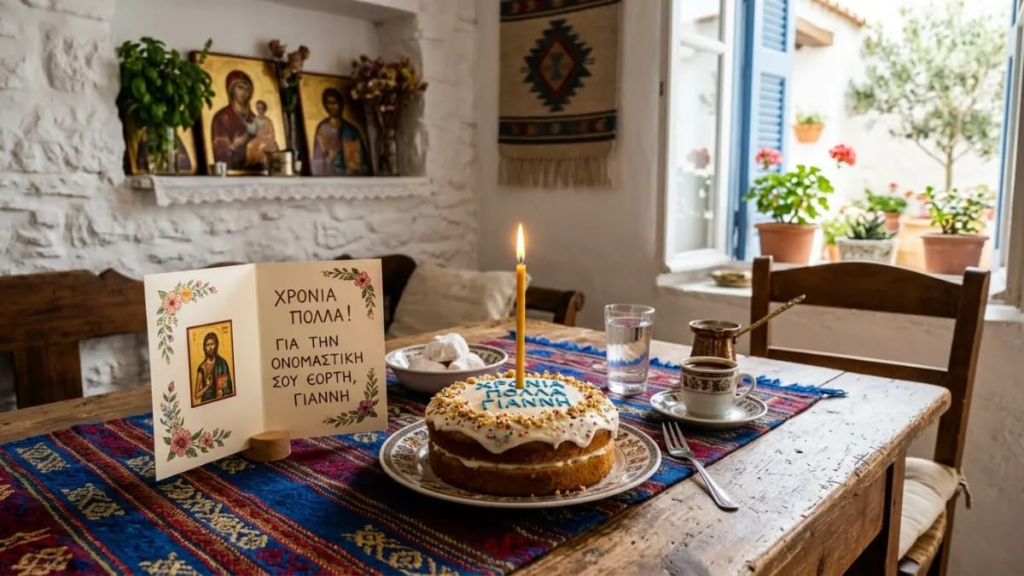
- Name days, celebrated on the feast day of a saint, are often more important than birthdays.
- Many first names have a customary short form, so Dimitrios becomes Dimitris and Nikolaos becomes Nikos.
- Some short forms use another short Greek name of similar sound, such as Paraskevas becoming Paris.
- Baptism is traditionally when a child’s name is formally given in Orthodox families.
Because of the name day custom, a person called Konstantinos or Eleni may have a specific date each year when friends and family greet them. It is one more reason Greek names feel connected to community and not only to the individual.
Greek Surnames and What They Tell You
Greek surnames are part of the picture too. Family names began among elite families in the Byzantine period, and many ordinary Greeks used patronymics or nicknames until the nineteenth century. Today a surname can hint at family origin.
Endings such as -opoulos often mean son of, as in Papadopoulos. The ending -idis is common among families with roots in the Black Sea region, and -akis is strongly linked to Crete. These are general patterns, not strict rules, so treat them as clues rather than proof.
Unique and Rare Greek Names
If you want something that few people will share, Greek has depth. Rare girl names include Agni, meaning chaste, Glykeria, meaning sweet, Evdokia, meaning to be well pleased, and Kallirroi, meaning beautiful flowing. Rare boy names include Asterios, meaning starry, Chrysanthos, meaning golden flower, and Theofylaktos, meaning watched by God.
Rare names do come with trade-offs. They are memorable, but they may be misspelled or mispronounced outside Greece. A good middle path is to pair a rare Greek first name with a simple middle name.
Tips for Choosing Greek Names
Choosing from a long list can feel overwhelming. A few practical steps help.
- Say the name out loud with your surname and check it flows.
- Look at the English spelling options and pick one you can live with.
- Check the meaning in more than one trusted source.
- Ask a Greek speaker how the name is really pronounced.
- Think about nicknames, because Greek short forms can sound very different from the full name.
If the name is for a character, the same logic applies. A Greek reader will notice if a fictional yiayia is called a name nobody has used for centuries, so match the name to the era and region.
How to Pronounce Common Greek Names
Stress matters in Greek. Nikolaos is said with the stress on the third syllable, and Eleni is said eh-LEH-nee. Greek g before e or i sounds closer to a y, which is why Giannis is said YAH-nees. Learning two or three of these rules makes most greek names much easier to say.
Vowel pairs can also trip people up. In Greek, the combination ai sounds like the e in bed, so Aikaterini is said eh-kah-teh-REE-nee. The letter combination ou sounds like oo, which is why Dimitrios is closer to dee-MEE-tree-os than the spelling suggests. If you are unsure, ask a Greek speaker or listen to a recording. Getting it right is a small sign of respect, and it saves the child years of correcting people.
Final Thoughts
Greek names carry meaning in almost every syllable, from Sofia and Zoe to Nikolaos and Leonidas. Whether you choose a gentle nature name, a mythological hero or a saint’s name with centuries of history, you are picking something with real roots. Check the meaning, say the name aloud, and choose the spelling that works best for your family. If you pick a name for a story, keep the era and region in mind.
FAQs
What are the most popular Greek names?
Sofia, Maria, Eleni, Katerina and Zoe are popular for girls. Nikolaos, Ioannis, Georgios, Dimitrios and Konstantinos are among the best-known for boys. Many of these also appear in English as Nicholas, John, George and Helen.
What do most Greek names mean?
Most Greek names come from real Greek words. Common themes are wisdom, victory, strength, life, nature and the gods. Many are compounds, so they combine two meaningful word parts.
What is a strong Greek name for a boy?
Leon (lion), Nikolaos (victory of the people) and Agamemnon (very steadfast) are strong choices. Leonidas, meaning son of the lion, is another popular pick.
What is a beautiful Greek name for a girl?
Sofia (wisdom), Eleni (bright light), Zoe (life) and Kalliopi (beautiful voice) are lovely options. Anthea, meaning flower, is another gentle choice.
Are Greek names from mythology still used?
Yes. Athena, Daphne, Iris, Orestis and Odysseas are all in use. After Greek nationalism grew, names from antiquity became popular again alongside saints’ names.
What is a name day in Greece?
A name day is the feast day of the saint a person is named after. Many Greeks celebrate it with family and friends, often as much as their birthday.
How do Greek surnames work?
Many surnames began as patronymics, nicknames, places or occupations. Endings like -opoulos, -idis and -akis can hint at family origins, though they are not exact rules.