
German names can sound strong, soft, classic or very modern. Some go back over a thousand years. Others are borrowed from Hebrew, Latin or Greek and shaped into German form.
This guide covers boy names, girl names, unisex options, surnames and pronunciation. It also explains how naming works in Germany today.
For more fun and unique naming inspiration, explore our Reindeer Names list.
Quick answer: German names are first names and surnames used in Germany and German-speaking regions. Many have Old German roots, such as Friedrich (“peaceful ruler”) and Mathilda (“battle-mighty”). Others, like Johannes and Sophia, came from Hebrew, Latin and Greek and took German forms over time.
What Makes a Name German?
There are two main groups. The first is true Germanic names, built from old word parts. The second is imported names that Germans adopted and adapted.
Old German names were often made by joining two elements. One part might mean “famous”, “strong”, “peace” or “wolf”, and the other “ruler”, “protector” or “battle”. That is why so many German names sound like small titles.
Take Wilhelm. It is usually explained as “will” plus “helmet”, so “resolute protector”. Heinrich means “home ruler”, and Ludwig means “famous warrior”.
Imported names are just as common. Johannes comes from Hebrew and means “God is gracious”. Maximilian is Latin for “greatest”. Sophia is Greek for “wisdom”. All three feel completely German today.
One thing to keep in mind: name meanings are not always settled. Where scholars disagree, this guide gives the most widely accepted meaning.
How German Names Work
A German person usually has one or more first names and a family name. Many children get two first names, and one of them is often a traditional middle name.
Middle names tend to stay steady over time. Sophie and Marie are long-running favorites for girls, and Alexander and Maximilian for boys. Those middle names have stayed the same since 2005.
Double first names are common too. In a 2025 analysis by name researcher Knud Bielefeld, 37% of children received at least two first names, and only about 3% got three or more. That study is representative but not official.
Surnames are a newer idea than most people expect. Family names came into use in Germany during the 1500s and became a legal requirement in the 1800s. In parts of northern Germany, names based on the father’s name were used until then.
Nicknames and Short Forms
Short forms are a big part of everyday use. Johannes often becomes Hans, and Friedrich becomes Fritz. Elisabeth turns into Liesel, Charlotte into Lotte, and Katharina into Kathi.
Some of these short forms were once full names of their own. Hans, for example, is still given as a first name and carries the same “God is gracious” meaning as Johannes. That is worth knowing if you see an older relative listed under both forms in family records.
Many parents now give the short form as the official first name. Names like Theo, Mila, Lotte and Fiete are good examples. They keep a traditional feel while sounding light and modern.
If you are exploring names from different cultures, take a look at our German Names guide.
Rules for Naming a Baby in Germany
Germany is stricter than many Western countries here. Parents must have their chosen name approved by the civil registration office, the Standesamt.
In general, the office can refuse a name that could harm the child’s wellbeing. Parents who pick something very unusual should expect questions. A traditional name will almost never be a problem.
This matters if you plan to give a German name to a child born in Germany. It does not apply the same way elsewhere. Parents in the USA or UK are free to choose German names without any approval step.
German Names and Meanings For Boys
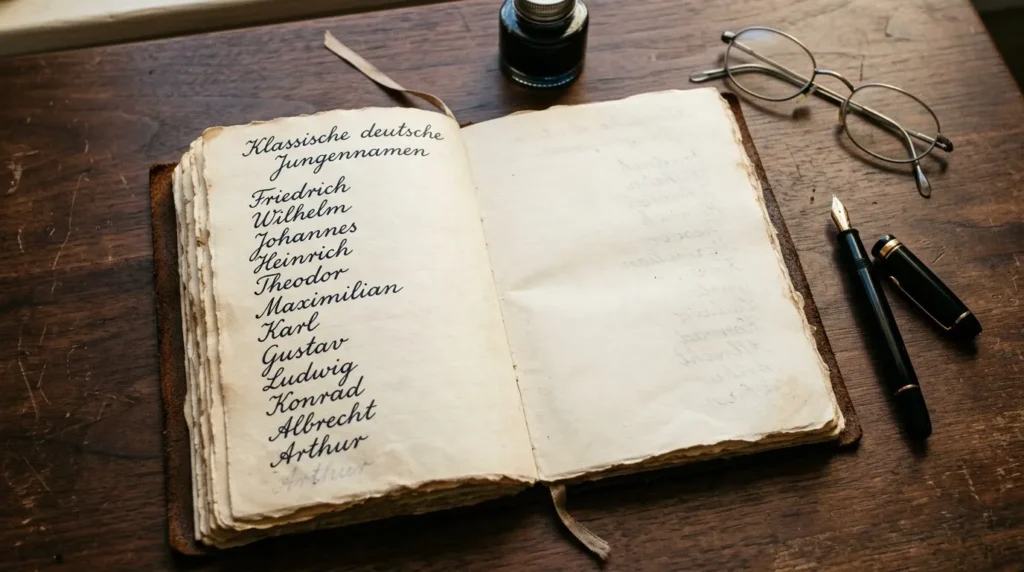
Classic German boy names tend to be short and firm. Many end in a hard consonant. Here are some of the best known, grouped by style.
Classic Old German Names For Boys
| Name | Meaning | Note |
| Friedrich | Peaceful ruler | Often shortened to Fritz |
| Wilhelm | Resolute protector | English form is William |
| Heinrich | Home ruler | English form is Henry |
| Ludwig | Famous warrior | Often linked to the English name Louis |
| Konrad | Bold counsel | Short form is Kurt |
| Karl | Free man | English form is Charles |
| Otto | Wealth, fortune | Short and easy to say |
| Dieter | Army of the people | Common in older generations |
| Siegfried | Victorious peace | Linked to German legend |
| Wolfgang | Wolf path | Made famous by Mozart |
Boy Names Borrowed From Other Languages
These came to Germany through religion and trade, then became everyday German names.
| Name | Origin | Meaning |
| Johannes | Hebrew | God is gracious |
| Jakob | Hebrew | Supplanter |
| Jonas | Hebrew | Dove |
| Elias | Hebrew | My God is Yahweh |
| Maximilian | Latin | Greatest |
| Florian | Latin | Flowering |
| Anton | Latin | Often given as “priceless” |
| Felix | Latin | Lucky, happy |
| Leon | Greek | Lion |
| Stefan | Greek | Crown, garland |
Short Northern and Modern Boy Names
Northern Germany leans toward short names with Frisian or Scandinavian roots. Mats, Fiete and Finn are typical of the north. Sven, a Scandinavian-origin name often translated as “young man”, also fits here.
Newer favorites include Theo, Milo, Luca and Elias. They are short, easy to say in other languages and work well outside Germany.
If you want something rarer, Kilian is a good option. It is often given as “little church”, though some sources link it to an Irish name.
German Girl Names and Meanings
German girl names range from sturdy medieval names to soft, modern ones. Many old names carry warrior meanings. Newer picks lean toward short, vowel-rich sounds.
Old German Girl Names
| Name | Meaning | Note |
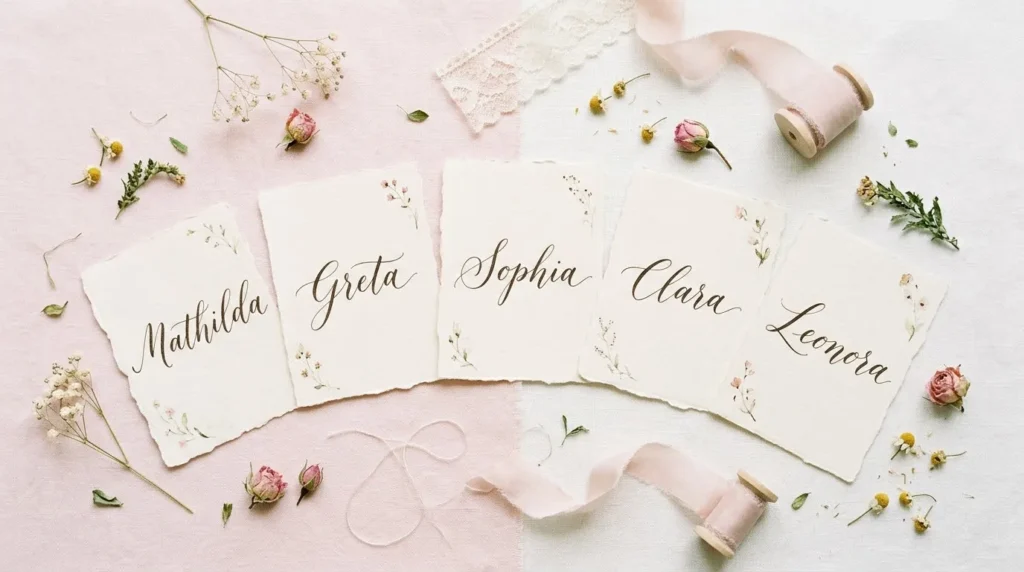
| Mathilda | Battle-mighty | Also spelled Matilda |
| Gisela | Pledge | Old High German origin |
| Luisa | Famous warrior (feminine form) | Related to Ludwig |
| Adelheid | Noble kind | Short form is Heidi |
| Hedwig | Battle strife | Rare today, seen in older generations |
| Frieda | Peace | Short form of names like Friederike |
| Ida | Industrious one | Short and has returned to fashion |
| Emma | Universal | Linked to an old Germanic word element |
| Hilde | Battle | Short form of names ending in -hild |
Girl Names Borrowed From Other Languages
| Name | Origin | Meaning |
| Sophia | Greek | Wisdom |
| Hannah | Hebrew | Grace |
| Anna | Hebrew | Grace |
| Johanna | Hebrew | God is gracious |
| Klara | Latin | Bright, clear |
| Katharina | Greek | Often given as “pure” |
| Greta | Greek via Margareta | Pearl |
| Charlotte | French | Feminine form of Charles, “free man” |
| Lena | Various | Short form of names like Helena or Magdalena |
One name has a story of its own. Lorelei comes from a steep rock on the Rhine River and a legend about a singing maiden. It is sometimes explained as “alluring”, though the name’s roots are debated.
Sophie, Marie and Lotte are classic German favorites. Lotte is a short form of Charlotte, and Liesel is a pet form of Elisabeth. Parents often pair a short first name with a longer middle name.
Unisex German Names
Gender-neutral names are less common in Germany than in the USA. Legal practice has also leaned toward names that are clearly recognized as first names. Still, several short names are used for any child, often as nicknames for longer ones.
| Name | Origin or short form of | Meaning |
| Alex | Alexander or Alexandra | Defender of people |
| Robin | Robert | Bright fame |
| Toni | Anton or Antonia | Priceless (traditional explanation) |
| Lou | Ludwig or Luise | Famous warrior |
| Adel | Old High German adal | Noble |
Check how a unisex name is treated in your own country before you commit. Some are common for one gender in English-speaking places and the other in Germany.
Most Popular German Names Right Now
Sophia and Noah were the most popular names for babies born in Germany in 2025. Sophia overtook Emilia, which had held first place for girls since 2022, while Noah kept the top boys’ spot for another year.
The data comes from the Gesellschaft für deutsche Sprache (GfdS), which analyzed about 830,000 entries from roughly 750 registry offices, covering about 91% of names given in 2025. A second ranking by Knud Bielefeld also put Sophia and Noah first.
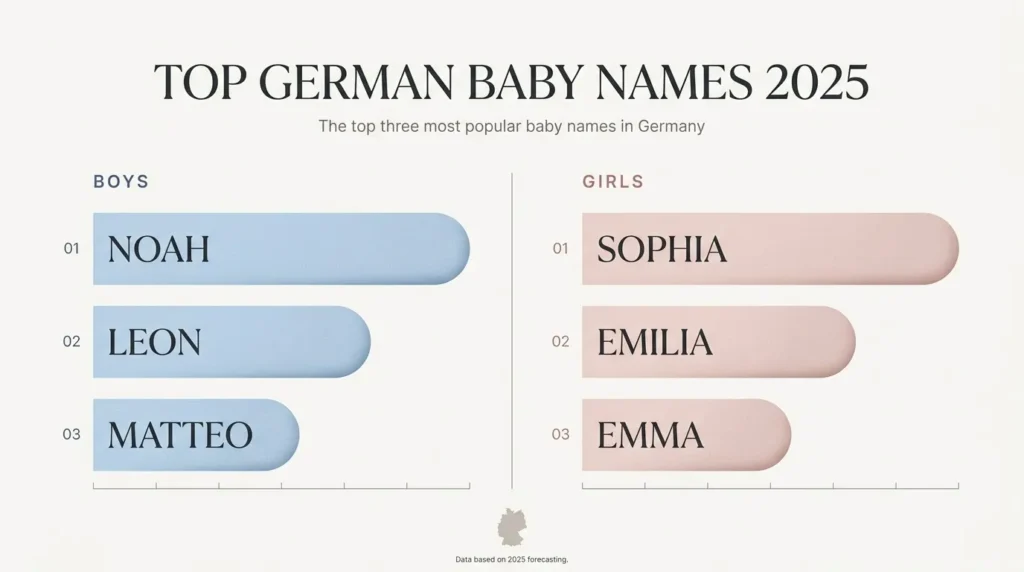
Even so, no name dominates. The ten most common names together covered only about 6.2% of babies born in 2025. German parents like familiar names, but they also want their child to stand out a little.
Regional Differences
Germany’s regions have their own tastes. In Bavaria, Felix and Sophia were the top names in 2025. In Berlin and Brandenburg, Bielefeld found Hannah and Noah in first place.
The north often favors names like Mats, Fiete and Finn. Traditional names are also shifting. In Bavaria, Maximilian fell out of the top ten first names in 2025 and is increasingly used as a second name.
Names rising in Germany include Anton, Leo, Theodor, Carlo and Emilio, based on one analysis of birth statistics.
For comparison, the first GfdS list in 1977 had Stefanie at number one for girls. Tastes change quickly.
German Surnames and What They Mean
Many German surnames describe a job, a place or a trait. They are easy to decode once you know a few words.
| Surname | Meaning | Type |
| Müller | Miller | Occupation |
| Schmidt | Smith, metalworker | Occupation |
| Schneider | Tailor | Occupation |
| Fischer | Fisherman | Occupation |
| Weber | Weaver | Occupation |
| Klein | Small | Trait |
| Schwarz | Black (hair or complexion) | Trait |
| Neumann | New man, newcomer | Trait |
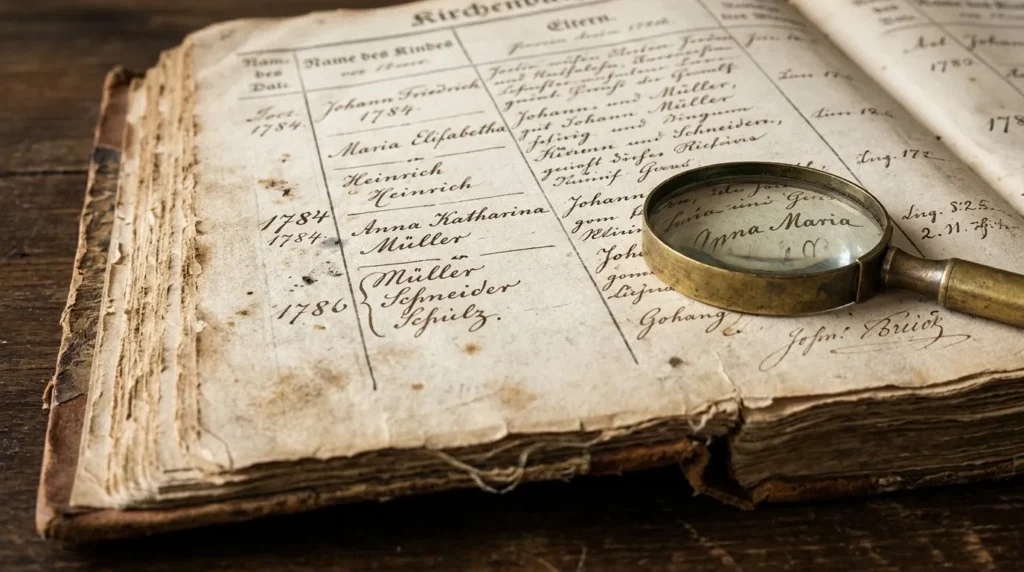
Some families took names from their farms. These are called Hofnamen, and they usually reflect where a person farmed.
Spelling also changed when families moved abroad. Many German immigrants to North America changed their names on purpose, and others were spelled by ear by immigration workers. Müller became Miller and Schneider became Snyder or Schneider in many families. If you are tracing roots, search several spellings.
How to Pronounce German Names
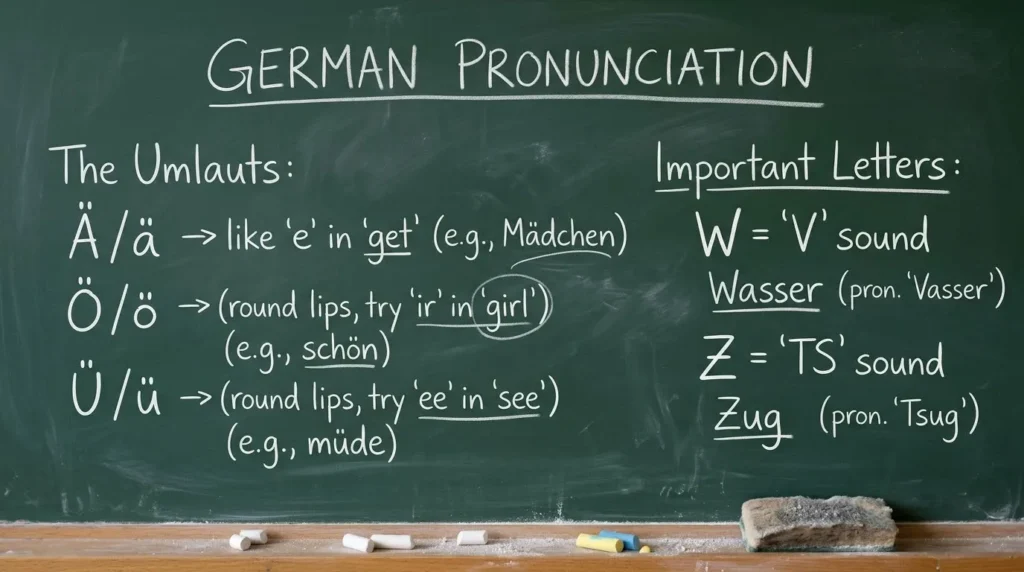
German spelling is more regular than English. Once you know a few rules, most names are easy.
- W sounds like an English V, so Wilhelm is VIL-helm
- V often sounds like F, as in Volker (FOL-ker)
- J sounds like an English Y, so Jakob is YAH-kop
- Z sounds like TS, and S before a vowel often sounds like Z, so Sophie is ZOH-fee
- Sch sounds like SH, as in Schneider (SHNY-der)
- Ei sounds like eye and ie sounds like ee, so Friedrich is FREE-drikh
- Eu and äu sound like oi in boy, as in Mäuser
Umlauts change the vowel sound: ä, ö and ü. If a keyboard or form does not allow them, they are written as ae, oe and ue. So Jürgen becomes Juergen and Müller becomes Mueller. The letter ß is written as ss.
Tips for Choosing a German Name
- Say the full name aloud with your surname to check the flow
- Look at how the name is pronounced in English, since W and J change sound
- Think about nicknames, such as Fritz for Friedrich or Lotte for Charlotte
- Check spelling options and decide whether you want the umlaut
- Consider the middle name tradition and pair a short first name with a longer one
- Confirm the meaning with a reliable dictionary or name source
Names with Hebrew or Latin roots, such as Johannes or Maximilian, are the easiest to use abroad. Older Germanic names like Konrad or Hedwig will feel more distinct.
Final Thoughts
For more name meanings and origins, explore name meanings and origins.
German names offer a wide range. You can pick a strong old name like Wilhelm or Mathilda, a short modern one like Theo or Mila, or a borrowed classic like Johannes or Sophia.
Meanings can differ slightly from source to source, so confirm any name that matters to you. If you are naming a child in Germany, remember the Standesamt will review the choice. Elsewhere, you are free to choose.
Whatever you decide, say it out loud first. A good name sounds right for years.
FAQs
What are the most popular German names?
In 2025, Sophia and Noah were the most popular names for babies born in Germany. Emilia, Emma, Elias and Felix are also common, depending on the region.
What are some traditional German boy names?
Friedrich, Wilhelm, Heinrich, Ludwig, Konrad and Karl are traditional choices. They all come from Old German word parts.
What are some traditional German girl names?
Mathilda, Gisela, Luisa, Adelheid and Frieda are traditional. Sophie, Marie and Lotte are long-running favorites.
Does Germany have rules for baby names?
Yes. Parents must have a name approved by the Standesamt, and a name can be refused if it could harm the child.
What is the most common German surname?
Müller is widely cited as the most common, followed by names like Schmidt and Schneider. Check a current source for exact rankings.
How do you pronounce German names?
W sounds like V, J like Y, Z like TS and sch like SH. For example, Jakob is YAH-kop and Wilhelm is VIL-helm.
Can I use a German name if I do not live in Germany?
Yes. Outside Germany there is no approval step, so you can choose any German name freely.